The 2020 Integration Symposium explored contemplative practices and their transformative impact, interpersonal trauma and recovery, and the holistic approach of womanist psychology.
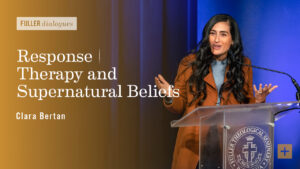
In response to Julie Exline’s lecture on “Supernatural Attributions and Mental Health,” Clara Bertan asks what it looks like to intentionally create a safe and inviting space for clients to explore their beliefs in the supernatural.
In her lecture “Spiritual Struggle: An Overview of Key Concepts and Findings,” delivered at the 2023 Integration Symposium, Julie Exline surveys varieties of spiritual struggle through the lens of mental health, with a particular focus on the idea of anger towards God.
In response to Julie Exline’s lecture on “Navigating Spiritual Struggles,” Jaclyn Williams draws from her experience as a chaplain and discusses pastoral and spiritual care for those encountering spiritual struggles.
In response to Julie Exline’s lecture on “Navigating Spiritual Struggles,” Grace Chan reflects on how our contexts—environment, family, society—form our ideas of spirituality and on why it matters to recognize this in the therapy room.
In her lecture “How Can We Support Healing and Growth from Spiritual Struggle?,” delivered at the 2023 Integration Symposium, Julie Exline considers ways to support and foster growth among people who experiencing spiritual struggles.
In response to Julie Exline’s lecture on “Healing and Growth from Spiritual Struggle,” Eltice Lin talks about navigating supernatural experience amidst different cultural and religious contexts.
Kenneth Wang considers lessons on resentment and reconciliation as he looks at the older brother in the Parable of the Prodigal Son, through a psychological perspective.
As he directs the counseling center of Pasadena’s Lake Avenue Church, Tsega Worku strives to create a space of healing and restoration for the hurting.
In the fifth of seven videos on “Extended Cognition,” Brad Strawn talks about how theological claims can be put to psychological tests and how psychology speaks to and informs our theology.
In the sixth of seven videos on “Extended Cognition,” Brad D. Strawn engages with the theological question of divine and human relationship and responsibility.
In the last of seven videos on “Extended Cognition,” Brad D. Strawn says that who we are as people—our identities, backgrounds, personalities—deeply impacts the ways we minister.
In the fourth of ten videos on “The Church as Family System,” Cameron Lee talks about ways of taking responsibility for how we are in relationship with others.
In the seventh of ten videos on “The Church as Family System,” Cameron Lee explains how family systems theory shapes the way we read and interpret the biblical text.
In the last of ten videos on “The Church as Family System,” Cameron Lee hopes that the psychological sciences might help equip us for the ministries to which God has called us.
In the sixth of seven videos on “Pursuing Truth Through Empirical Science,” Kenneth T. Wang discusses empathy and the ways God empathizes with our human experience and emotions.
In the last of seven videos on “Pursuing Truth Through Empirical Science,” Kenneth T. Wang encourages humility as he emphasizes the reality that none of us are perfect of self-sufficient.
In the last of nine videos on “The Cognitive Sciences and Belief,” Kutter Callaway summarizes how understanding the cognitive sciences in relation to our faith helps ministry leaders in areas of teaching and discipleship.
In the last of seven videos on “The Science of Thriving,” Pamela Ebstyne King reflects on how the psychological sciences help us reach the ends that theology and faith identify.
In the first of six videos on “Complex Dynamical Systems,” Warren S. Brown introduces how neuroscience helps us have an embodied understanding of the nature of persons.
In the second of six videos on “Complex Dynamical Systems,” Warren S. Brown describes people as complex systems that are organized in deep relationality.
In the third of six videos on “Complex Dynamical Systems,” Warren S. Brown shares about how persons’ lives are built through continuous reorganizing and adapting in the face of new situations.