
We’ve all had to choose between the “lesser of two evils” at some point. Sometimes the choice is simple: Of course you’d break the speed limit on the way to the emergency room if your child was bleeding to death in the back seat of the car.
But such choices aren’t usually so easy, especially when it comes to ethics and the law. At what point do one’s morals and principles trump an action that might be unethical or even illegal, in the name of what we might call “the greater good”? And are we willing to accept the consequences for such a decision—including pain, prison, or even death?
Thoreau. Gandhi. King. Parks. Mandela. Bonhoeffer. The list of those who have engaged in civil disobedience is a long one. And years from now, the name DeChristopher might just be uttered along with those other historical figures.
Who?
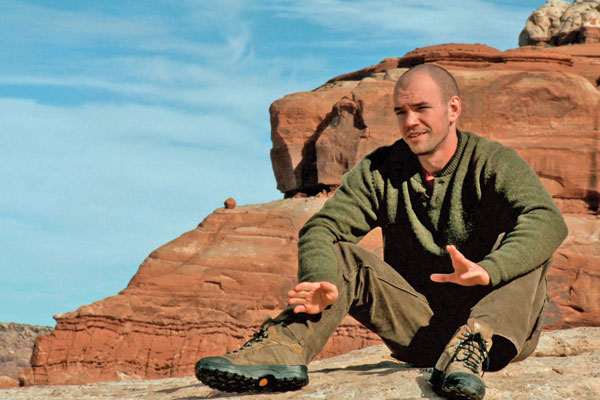 Tim DeChristopher is an American climate activist who just recently finished a 21-month prison sentence for his own act of civil disobedience. DeChristopher’s fascinating and conscience-churning story is chronicled in Bidder 70 (First Run Features), a new documentary now playing in limited theaters. The film, unexceptional in its execution but compelling as a profile of a young activist finding his voice, comes to DVD on July 16.
Here’s the story: In December 2008, in the final days of the Bush administration, the Bureau of Land Management hastily scheduled an auction to sell gas and oil drilling rights to more than 150,000 acres of publicly-owned land in Utah, much of it beautiful, pristine wilderness. DeChristopher, then 27, showed up at the auction with no intent other than to quietly protest. But when he was invited into the bidding room and given an auction paddle—with the number 70, thus the film’s title—he saw an opportunity.
He ended up bidding $1.8 million and winning 22,000 acres of land, with no intention to drill . . . or to pay. He was removed from the room by federal agents, taken into custody, and questioned. He was later indicted on a two-count felony for violation of the Federal Onshore and Gas Leasing Reform Act and making false statements. DeChristopher pleaded “not guilty” to both charges, and welcomed an opportunity to bring his case to trial, thinking it would be a platform for voicing his concerns about the environment, climate change, and the justice system.
Oh, and he thought he could win, too.
.jpg) DeChristopher and his defense attorneys thought he had a shot at an acquittal. They wanted to use a “necessity defense,” arguing that DeChristopher had to choose between two evils and that his actions resulted in the lesser of the two, where no legal alternative was available. But federal prosecutors and the presiding judge prohibited that defense, sending DeChristopher’s team back to the drawing board.
DeChristopher and his defense attorneys thought he had a shot at an acquittal. They wanted to use a “necessity defense,” arguing that DeChristopher had to choose between two evils and that his actions resulted in the lesser of the two, where no legal alternative was available. But federal prosecutors and the presiding judge prohibited that defense, sending DeChristopher’s team back to the drawing board.
Meanwhile, the auction itself had since been deemed unlawful when, in January 2009, a U.S. District judge halted the sale of 77 parcels, citing Bureau of Land Management violations of environmental laws protecting air quality and history preservation. Shortly thereafter, Interior Secretary Ken Salazar shelved the 77 parcels—including some won by DeChristopher—and lambasted the Bush administration for rushing the auction.
But the judge in DeChristopher’s case prohibited him from that defense as well; his team could not argue that the case should be dismissed even though the auction itself had been declared illegal. The film follows DeChristopher, his attorneys, and Peaceful Uprising, the environmental group that DeChristopher founded, as the months go by and the trial is postponed a number of times.
While awaiting trial, DeChristopher gives speeches and rallies the troops, and one can’t help but be on his side, hoping that one individual, in his nonviolent rage against the machine, might prevail. Who doesn’t want to see the Little Guy take down The Man?
 It all makes for compelling documentary material, complete with protest songs and a soundtrack meant to rally the viewer to DeChristopher’s perspective. But the film’s most captivating moments come on the morning of the trial. The camera is with him, alone in his home, getting dressed and fixing breakfast. No megaphones, no crowds, no media, no soaring soundtrack. Just silence . . . and a lot of tension. We hear the creak of the floors, the sizzling of the egg sandwich, and, most of all, DeChristopher’s heavy sighs. After months of confident defiance and inspired rhetoric, he’s now just a scared young man. And it’s palpable.
He never had a chance at the trial, since the judge disallowed all of his defense team’s proposed strategies. After being found guilty, DeChristopher addresses his many supporters on the courthouse steps with an extemporaneous speech that is quite eloquent and powerful. Tears flow, fists are raised.
 When he is later sentenced to two years, DeChristopher’s supporters block the streets of downtown Salt Lake City in an act of mass civil disobedience; 26 are arrested. Similar demonstrations, and many more arrests, are held across the nation.
DeChristopher ended up serving 21 months. He was released April 21, 2013, and is now on three years of probation. He will attend Harvard Divinity School this fall, and is currently touring with Bidder 70 and speaking about his experiences.
DeChristopher is driven by his love for the environment and his concerns about global warming, which he calls the “greatest moral imperative” of his generation. “It’s hard not to feel despair,” he says. “It’s not just about the planet. It’s about saving human lives.”
Whether one agrees with his views on the environment or climate change is no matter. His ideas are not radical; they reflect a genuine love for creation and a desire to keep it clean and healthy for humankind. And his passion is laudable.
 In a brief on-camera interview, actor, director, and environmentalist Robert Redford, who lives in Utah, praised DeChristopher’s courage and lambasted the court’s decision. “It’s unconscionable,” says Redford, 76. “It’s profoundly wrong.” Redford mentions the greedy tycoons of Wall Street who sent the country into a recession, but suffered no consequences. He wonders aloud why a young man like DeChristopher, who has done nothing violent and was only acting selflessly out of love for the environment and his fellow man, has to go to jail while the financial fat cats went unpunished.
For the viewer, the film prompts some soul-searching. What am I willing to go to prison for? What issues do I feel strongly enough about to take such action myself, even if the consequences are unpleasant?
Important questions.
And DeChristopher’s words to the court at his sentencing are worth considering:
“The people who are committed to fighting for a livable future will not be discouraged or intimidated by anything that happens here today. And neither will I. I will continue to continue to confront the system that threatens our future. Given the destruction of our democratic institutions that once gave citizens access to power, my future will likely involve civil disobedience. Nothing that happens here today will change that. I don’t mean that in any sort of disrespectful way at all, but you don’t have that authority. You have authority over my life, but not my principles. Those are mine alone.”
Are we all as willing to take a stand for our own principles?
Mark Moring is a copy writer at Grizzard Communications, where he writes for nonprofit organizations, and an Editor at Large at Christianity Today magazine, where he supervised pop culture coverage for years. He and Nina, parents of two fine young men named Peter and Paul, live in the Atlanta suburbs, where the whole family loves watching movies.