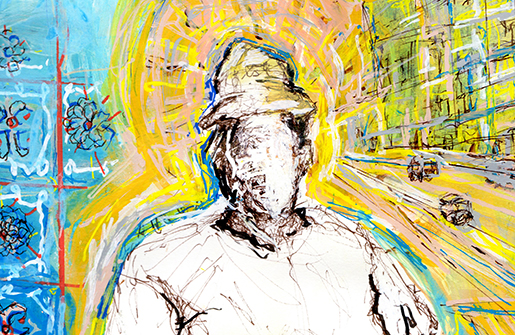
Illustration by Bea Rios
Fuller’s Centro Latino and Fuller Youth Institute recently partnered with the Brown Church Institute to research the unique contextual needs of Latina/o youth ministries. The study aimed to address demographics, pressing issues faced by Latina/o youth pastors, resource needs, and the existing ministry resource ecosystem. Released in Fall 2023, the findings of this research are available in the report Investigating the Contextual Needs of Latina/o Youth Pastors and Youth Workers.1*
In response to our presentations of this report to several youth worker groups across the country, youth workers typically felt seen and understood, and it is evident that we need to continue the academic work of studying the contexts of Latinas/os in faith communities. Part of this work’s importance is how it acknowledges realities that young people, youth workers, older adults, and church leaders have experienced but might not have been previously able to express. The insights of research led by our community and for our community serve as tools to see ourselves more clearly and provide a common language for discussion and action. Instituto Fe y Vida and New Generation3 are a few organizations that have engaged in
this work.
The report also confirms that the contexts and needs of youth ministry are the contexts and needs of the entire church. The communal aspect of our cultures and the familial and generational connections of our communities don’t stop at the threshold of the youth room or the main sanctuary. La iglesia is an ecosystem where historical, family, and cultural dynamics have consequences throughout. What is felt by la juventud is not just a juventud issue. Issues such as low spiritual vitality or low emotional health in younger generations are symptoms of generational trauma and intergenerational tensions around immigration, culture, language, and more. And these are not just issues of a singular generation. These are issues of the church as an institution, issues of our cultures, issues of our communities, issues of
our families.
Young people in the Latina church are not detached from the corporate faith community nor are we in a proverbial gestation period waiting to be the church of tomorrow. Because we are part of the Latina church now, we are the Latina church
of today.
We are the Latina church of today, wanting to be faithfully and holistically engaged in our local communities. We are the Latina church of today, embodying complex cultural identity intersections. We are the Latina church of today, seeking to live a holistically integrated faith. We are the Latina church of today, with the prophetic imagination to seek intergenerational healing and reconciliation as a collective flourishing.
¡Hermanas y hermanos, vamos! Let’s be the church.

Roslyn M. Hernández creates resources for the spiritual formation and empowerment of emerging generations through her work as podcast producer at Chasing Justice and project manager at Fuller Youth Institute. As a contributor at Think Christian, her thought- provoking articles and conversations bridge the gap between faith and pop culture. Roslyn is also a spiritual director and public theologian, providing space for holy listening, discernment, deconstruction, decolonizing, and healing. She holds a BA in Film & Media Studies and Spanish and a minor in Art History from UC Santa Barbara, and an MDiv with an emphasis on Youth, Family, and Culture from Fuller Seminary. When she’s not writing, she can be found enjoying nature as a spiritual practice, indulging her love for travel, learning about ancestral culinary traditions, or relishing solitude while sipping herbal teas.
Fuller’s Centro Latino and Fuller Youth Institute recently partnered with the Brown Church Institute to research the unique contextual needs of Latina/o youth ministries. The study aimed to address demographics, pressing issues faced by Latina/o youth pastors, resource needs, and the existing ministry resource ecosystem. Released in Fall 2023, the findings of this research are available in the report Investigating the Contextual Needs of Latina/o Youth Pastors and Youth Workers.1*
In response to our presentations of this report to several youth worker groups across the country, youth workers typically felt seen and understood, and it is evident that we need to continue the academic work of studying the contexts of Latinas/os in faith communities. Part of this work’s importance is how it acknowledges realities that young people, youth workers, older adults, and church leaders have experienced but might not have been previously able to express. The insights of research led by our community and for our community serve as tools to see ourselves more clearly and provide a common language for discussion and action. Instituto Fe y Vida and New Generation3 are a few organizations that have engaged in
this work.
The report also confirms that the contexts and needs of youth ministry are the contexts and needs of the entire church. The communal aspect of our cultures and the familial and generational connections of our communities don’t stop at the threshold of the youth room or the main sanctuary. La iglesia is an ecosystem where historical, family, and cultural dynamics have consequences throughout. What is felt by la juventud is not just a juventud issue. Issues such as low spiritual vitality or low emotional health in younger generations are symptoms of generational trauma and intergenerational tensions around immigration, culture, language, and more. And these are not just issues of a singular generation. These are issues of the church as an institution, issues of our cultures, issues of our communities, issues of
our families.
Young people in the Latina church are not detached from the corporate faith community nor are we in a proverbial gestation period waiting to be the church of tomorrow. Because we are part of the Latina church now, we are the Latina church
of today.
We are the Latina church of today, wanting to be faithfully and holistically engaged in our local communities. We are the Latina church of today, embodying complex cultural identity intersections. We are the Latina church of today, seeking to live a holistically integrated faith. We are the Latina church of today, with the prophetic imagination to seek intergenerational healing and reconciliation as a collective flourishing.
¡Hermanas y hermanos, vamos! Let’s be the church.
Roslyn M. Hernández creates resources for the spiritual formation and empowerment of emerging generations through her work as podcast producer at Chasing Justice and project manager at Fuller Youth Institute. As a contributor at Think Christian, her thought- provoking articles and conversations bridge the gap between faith and pop culture. Roslyn is also a spiritual director and public theologian, providing space for holy listening, discernment, deconstruction, decolonizing, and healing. She holds a BA in Film & Media Studies and Spanish and a minor in Art History from UC Santa Barbara, and an MDiv with an emphasis on Youth, Family, and Culture from Fuller Seminary. When she’s not writing, she can be found enjoying nature as a spiritual practice, indulging her love for travel, learning about ancestral culinary traditions, or relishing solitude while sipping herbal teas.
Drawing on the stories of Centro Latino alumni, Johnny Ramírez-Johnson, professor of anthropology, explains the distinct ways Centro Latino equips and forms its students.