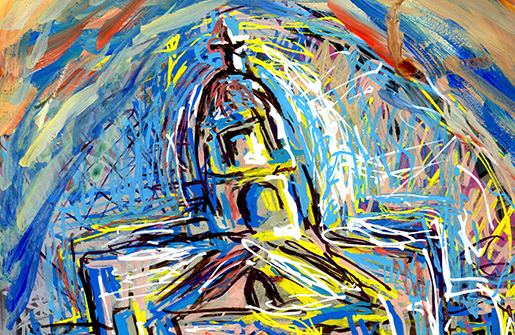

Illustration by Bea Rios
Justo González recently wrote about how Spanish theological education in the USA has evolved from viewing pastors’ education as a pipeline—from church membership (having no theological education), to the seminary (to learn sophisticated theology), to the academy to teach a Hispanic perspective. This tubular imaginary is a lineal and restrictive view of theological education. But, at Fuller, we have embraced a more inclusive and wider perspective—just as González imagines such education today:
The purpose of a pipeline is to carry its contents to their final destination, and every single drop that does not reach that destination is considered a loss that must be prevented. In contrast, the purpose of an irrigation hose is not to make certain that every drop reaches the end of the line, but rather to see that every drop that runs through it finds its proper function irrigating the land around it. Obviously, some water must reach the end of the hose, for the land there must also be irrigated. But a drop that reaches that end is no better nor more valuable than any other drop.1
These words of González are fully embraced at Fuller’s Centro Latino, where we professors view students and church members as equals in ministry. What then is the role of the educational irrigation that González invites us to do?
First, we equip the student for fully accepting and embracing the wholeness of the potential that they already have, given by God and used by the Holy Spirit. Many, perhaps most, of our students arrive to us with a view of themselves as inadequate—that is the way they are mostly defined by their cultural surroundings in the USA. At Fuller, we help them see themselves as God sees them.
Second, we equip students to see the Holy Spirit and God as the owners and arbiters of the mission of preaching the gospel. Mostly students arrive believing that God, truth, and Holy Spirit abide only within the confines of their church building! Yet the Holy Spirit has always irrigated both church members as well as those who do not know God by name (as with Cyrus in Isaiah 45).
Third, we equip students to use all tools because God owns all tools. The pipeline mindset assumes that only the origin and the destination belong to God. The irrigation metaphor assumes God owns the whole of the arts, sciences, and the peoples of planet earth. Thus, we teach to partner and to follow the Holy Spirit’s missionary adventures in the world by asking: What is the Holy Spirit already doing in this community? Once identifying the workings of the Spirit, then, partnering with that work and the people carrying the work out. No church or pastor brings the Holy Spirit to a community; the Holy Spirit wants to use and to lead the pastor and the church community to partner in ministry.
Perspectives from Centro Latino Alumni
Writing about the meaning of something as fluid as education demands full disclosure of one’s perspectives. I hereby acknowledge that I am an extremely positive-biased participant of Fuller’s education! My perspectives were fixed back in the 1981 Winter Quarter. My family drove north from Costa Rica all the way to Pasadena; it was a great trip. I chose to spend that Winter Quarter at Fuller because I had taught an introduction to the Bible course, and as part of my research, I had dug out, in a world before the internet, the positions on inspiration and revelation of various seminaries in the USA and had fallen in love with Fuller’s statements on this topic. When we arrived at Fuller, I fell in love again, this time, with Dr. George Gay, founder of what now is Centro Latino. Now, I serve as professor of anthropology and teach various courses in contextualization and social sciences research as well as evangelism and missiology.
In this article, I will be pairing my own perspectives in conversation with the perspectives of three graduates of Centro Latino master’s programs. These perspectives further enrich the meaning of Fuller’s take on theological education.
Love for the Bible
The first element of Centro Latino’s theological education is a deep and
all-encompassing love for the Bible and its authoritative words on faith and practice. At Centro Latino, we all love the biblical narratives, and the teaching we do—regardless of the topic—is always imbued and defined by biblical examination
and exploration.
When Pastor Jenny Rivera, youth leader at Covenant Church in Eagle Rock, California, describes the learning philosophy at Fuller’s Centro Latino, she shares how she was challenged in her classes to engage mind and feelings in order “to help believers know and experience God and his Word.” She declares that “with the help of the Spirit and the Bible” her classes helped her to “discern and discover my gifts and how they can build up the body of Christ.” Such holistic objectives define Centro Latino’s goals for all its students.
After being a minister in Puerto Rico, Pastor Rivera is now embarking on a new artistic endeavor (Jengamarie ART) informed by this engagement with the Word. She credits Fuller with giving her an excellent education that helps her “evoke feelings, emotions and images” following her “abstract-expressionist artistic approach.” Fuller equipped Jenny with tools to serve the people of God as a pastor and as an artist. Centro Latino students have many opportunities for synergy with the various centers and institutes Fuller has, including opportunities to develop various art forms at the Fuller Brehm Center. At Fuller, we take seriously faith, science, and the arts as vehicles for spreading biblical truths of Jesus as Lord and Savior.
Formational Community
Fuller’s examination of biblical truths in its academic offerings is done from a postcolonial perspective that fully submits its views to biblical teachings and does so in a community of students and professors who have their own unique experiences and contexts. Alberto Embry describing his Fuller education, began by saying, “The whole experience was full of wonderful ‘culture shocks.’” Mr. Embry is coordinator of young adult ministry (Spanish) at the Los Angeles archdiocese of the Roman Catholic Church. Along with all Catholic students I have taught at Fuller (a small but representative number of CL students), he has provided food for lively theological discussion among students and professors.
For Alberto “realizing that [as a Catholic] I was not the majority” was an “important moment” for learning from others—as well as sharing his views with others. For me as his teacher, advisor, and friend, his words about Fuller’s professors mean a lot: “I see Fuller’s teachers as professionals who are sharing their knowledge at the highest level, but are also ready to share their vocation of teaching and training.” Yes, CL theological education is not about knowledge alone.
Inclusive Evangelistic Vision
Fuller’s education is meant to challenge the vocational aspirations and sharpen the evangelistic abilities of our students. The testimony of Supervisory Bishop Mario Eduardo Alas Escalante, founder of The Promise Church (of the Apostolic Assembly) located in Chula Vista, California, is paradigmatic.
In Dr. Ramírez-Johnson’s evangelism class, part of an assignment was to identify “the not included,” and this led me to observe the people of my congregation who sit at the very back of the church—those who are in the shadows because they aren’t acknowledged or taken into account. From my pulpit’s perspective, on the corner of the right side, next to the sound booth, was a young man in torn pants, his arms and neck full of blasphemous tattoos. He had a shaved head and red eyes, and he held a chain in his hands, which he played with, while observing the service. He ran the chain between his fingers like a rosary with which he was praying a penance. His name is Macrin, a rebellious and ungrateful young man of only 19 years of age, as “we” all
saw him.
Bishop Escalante reports how from a simple act of seeing the unseen at church—and because of a one-on-one greeting that simply acknowledged Macrin’s presence and welcomed his attendance—Macrin, the gang member, eventually requested Bible studies and was baptized. Macrin became an unlikely missionary! Macrin was transformed from being “seen” by the church to becoming a sponsored evangelist to an unreached Guatemalan village deep in the jungle!
Fuller’s theological education equips students called by God to see the world and its inhabitants—all of them, as they are—as candidates for the kingdom! Prejudice based on Bible law and Bible teachings often precludes the believer of reaching out to those in need of the gospel.
It is not enough to know your Bible, not enough to ask for the Holy Spirit’s guidance; like Bishop Mario, you are also called to see the unseen at church and in the world. This is a perspective that demands a change of heart and the development of postcolonial contextualization skills that we teach at Fuller’s Centro Latino.
Just like Pastor Rivera’s art is now a new tool for preaching salvation, Mr. Embry’s education has equipped him for his gospel work with the youth in Los Angeles, and Bishop Escalante’s inclusive vision became a tool for expanding the gospel calling of his church.
Diversity, Culture, and the Bible
A common element in these three testimonies is the importance of recognizing diversity and highlighting cultural issues when reading the Bible. There are many seminaries that teach the Bible; Fuller seeks to also teach cultural relevancy in a context of diversity.
Paraphrasing the words of Bishop Escalante, Fuller taught him that his “congregation has diversity in many ways.” Further, he learned to see diversity as good. In fact, he wrote, accepting diversity as God’s design “enables us to reach out to all the people.” Further, Bishop Escalante declared that “diversity is another word for Pentecostalism.”
Learning to see “the other” enables the preacher to preach the gospel to all. This enabling demands that the preacher engage in “a cultural experience” with their congregation. As illustrated by Bishop Escalante: “On the one hand, my church and I had a culture of holiness, while Macrin’s gang culture was rejected and not even acknowledged to exist by the church!” Engaging in the participant observation assignment of his evangelism class, Bishop Escalante was transformed—a transformation that would have been unlikely if only Bible reading defined the curriculum.
Pastor Rivera reported to me, “The theological education and experiences in the student community that I have acquired at Fuller have helped me have a new perspective on pastoral care for Latin-Afro-Caribbean women.” As a pastor, she herself had suffered discrimination. (From very early on, female pastoral inclusion has been a pillar of Fuller’s education.) Jenny further testified to me that, “Through different courses taken, interdisciplinary artistic experiences, and the reinforcement of spiritual disciplines I was able to understand the need for this change.” This is a common element for Centro Latino graduates: change, Pastor Rivera wrote, “from a ministerial focus on the center to a focus on the margins of society.”
Why do I write that Bible alone is not good enough? Simple: We can only read the Bible with our own eyes and our own culture. Like Peter had a vision on a roof that changed his definition of who is clean and who is unclean (Acts 10), at Fuller, we assign learning activities that the Holy Spirit can use to also change a pastor’s perspectives on the “unclean Gentiles,” like Macrin, of today.
A Discernment Exercise
What follows is an exercise that represents part of Centro Latino’s classroom experience—particularly for those contemplating Fuller as a place for their academic education in ministry:
1. Find a place of peace and tranquility where you can converse alone with the Holy Spirit seeking discernment.
2. Read Psalms 139:13–18 NRSVUE:
For it was you who formed my
inward parts; you knit me together in my mother’s womb.
I praise you, for I am fearfully and
wonderfully made. Wonderful are your works;
that I know very well. My frame was not hidden from you,
when I was being made in secret,
intricately woven in the depths of the earth.
Your eyes beheld my unformed substance.
In your book were written all the days that were formed for me,
when none of them as yet existed.
How weighty to me are your thoughts,
O God! How vast is the sum of them!
I try to count them—they are more
than the sand; I come to the end—I am still with you.
3. Pray. Read the passage again. Pray some more. Then ask yourself these questions: Am I wonderfully made? Is God pleased with what God sees
in my body and my whole being? Does God know more about me than I
know myself?
4. Now, ask yourself these questions: Is God calling me to a theological education that will empower me to see myself and to see “the other” as formed, shaped, and designed for pleasing God? Am I being led to become academically and vocationally equipped to follow the will of the Holy Spirit in fulfilling my calling to ministry?
Do you belong as a student of Fuller’s Centro Latino? We are eagerly waiting for you!
Johnny Ramírez-Johnson is professor of anthropology and profesor del Centro Latino. Hailing from Puerto Rico, Dr. Ramírez-Johnson received his master’s in Hebrew Scriptures and archaeology from Andrews University in Michigan and went on to obtain a master’s and doctorate at Harvard. Two books by Ramírez-Johnson apply the multicultural, intergenerational, and multilingual realities for North American churches in promoting not only love for Jesus but also healthy and holy lifestyles: A Way Up the Ladder, Motivation Achievement via Religious Ideology: An Ethnography of a Seventh-day Adventist Puerto Rican Church (2008) and AVANCE: A Vision for a New Mañana (2003). His research focuses on the intersection of the social sciences and theology.
Justo González recently wrote about how Spanish theological education in the USA has evolved from viewing pastors’ education as a pipeline—from church membership (having no theological education), to the seminary (to learn sophisticated theology), to the academy to teach a Hispanic perspective. This tubular imaginary is a lineal and restrictive view of theological education. But, at Fuller, we have embraced a more inclusive and wider perspective—just as González imagines such education today:
The purpose of a pipeline is to carry its contents to their final destination, and every single drop that does not reach that destination is considered a loss that must be prevented. In contrast, the purpose of an irrigation hose is not to make certain that every drop reaches the end of the line, but rather to see that every drop that runs through it finds its proper function irrigating the land around it. Obviously, some water must reach the end of the hose, for the land there must also be irrigated. But a drop that reaches that end is no better nor more valuable than any other drop.1
These words of González are fully embraced at Fuller’s Centro Latino, where we professors view students and church members as equals in ministry. What then is the role of the educational irrigation that González invites us to do?
First, we equip the student for fully accepting and embracing the wholeness of the potential that they already have, given by God and used by the Holy Spirit. Many, perhaps most, of our students arrive to us with a view of themselves as inadequate—that is the way they are mostly defined by their cultural surroundings in the USA. At Fuller, we help them see themselves as God sees them.
Second, we equip students to see the Holy Spirit and God as the owners and arbiters of the mission of preaching the gospel. Mostly students arrive believing that God, truth, and Holy Spirit abide only within the confines of their church building! Yet the Holy Spirit has always irrigated both church members as well as those who do not know God by name (as with Cyrus in Isaiah 45).
Third, we equip students to use all tools because God owns all tools. The pipeline mindset assumes that only the origin and the destination belong to God. The irrigation metaphor assumes God owns the whole of the arts, sciences, and the peoples of planet earth. Thus, we teach to partner and to follow the Holy Spirit’s missionary adventures in the world by asking: What is the Holy Spirit already doing in this community? Once identifying the workings of the Spirit, then, partnering with that work and the people carrying the work out. No church or pastor brings the Holy Spirit to a community; the Holy Spirit wants to use and to lead the pastor and the church community to partner in ministry.
Perspectives from Centro Latino Alumni
Writing about the meaning of something as fluid as education demands full disclosure of one’s perspectives. I hereby acknowledge that I am an extremely positive-biased participant of Fuller’s education! My perspectives were fixed back in the 1981 Winter Quarter. My family drove north from Costa Rica all the way to Pasadena; it was a great trip. I chose to spend that Winter Quarter at Fuller because I had taught an introduction to the Bible course, and as part of my research, I had dug out, in a world before the internet, the positions on inspiration and revelation of various seminaries in the USA and had fallen in love with Fuller’s statements on this topic. When we arrived at Fuller, I fell in love again, this time, with Dr. George Gay, founder of what now is Centro Latino. Now, I serve as professor of anthropology and teach various courses in contextualization and social sciences research as well as evangelism and missiology.
In this article, I will be pairing my own perspectives in conversation with the perspectives of three graduates of Centro Latino master’s programs. These perspectives further enrich the meaning of Fuller’s take on theological education.
Love for the Bible
The first element of Centro Latino’s theological education is a deep and
all-encompassing love for the Bible and its authoritative words on faith and practice. At Centro Latino, we all love the biblical narratives, and the teaching we do—regardless of the topic—is always imbued and defined by biblical examination
and exploration.
When Pastor Jenny Rivera, youth leader at Covenant Church in Eagle Rock, California, describes the learning philosophy at Fuller’s Centro Latino, she shares how she was challenged in her classes to engage mind and feelings in order “to help believers know and experience God and his Word.” She declares that “with the help of the Spirit and the Bible” her classes helped her to “discern and discover my gifts and how they can build up the body of Christ.” Such holistic objectives define Centro Latino’s goals for all its students.
After being a minister in Puerto Rico, Pastor Rivera is now embarking on a new artistic endeavor (Jengamarie ART) informed by this engagement with the Word. She credits Fuller with giving her an excellent education that helps her “evoke feelings, emotions and images” following her “abstract-expressionist artistic approach.” Fuller equipped Jenny with tools to serve the people of God as a pastor and as an artist. Centro Latino students have many opportunities for synergy with the various centers and institutes Fuller has, including opportunities to develop various art forms at the Fuller Brehm Center. At Fuller, we take seriously faith, science, and the arts as vehicles for spreading biblical truths of Jesus as Lord and Savior.
Formational Community
Fuller’s examination of biblical truths in its academic offerings is done from a postcolonial perspective that fully submits its views to biblical teachings and does so in a community of students and professors who have their own unique experiences and contexts. Alberto Embry describing his Fuller education, began by saying, “The whole experience was full of wonderful ‘culture shocks.’” Mr. Embry is coordinator of young adult ministry (Spanish) at the Los Angeles archdiocese of the Roman Catholic Church. Along with all Catholic students I have taught at Fuller (a small but representative number of CL students), he has provided food for lively theological discussion among students and professors.
For Alberto “realizing that [as a Catholic] I was not the majority” was an “important moment” for learning from others—as well as sharing his views with others. For me as his teacher, advisor, and friend, his words about Fuller’s professors mean a lot: “I see Fuller’s teachers as professionals who are sharing their knowledge at the highest level, but are also ready to share their vocation of teaching and training.” Yes, CL theological education is not about knowledge alone.
Inclusive Evangelistic Vision
Fuller’s education is meant to challenge the vocational aspirations and sharpen the evangelistic abilities of our students. The testimony of Supervisory Bishop Mario Eduardo Alas Escalante, founder of The Promise Church (of the Apostolic Assembly) located in Chula Vista, California, is paradigmatic.
In Dr. Ramírez-Johnson’s evangelism class, part of an assignment was to identify “the not included,” and this led me to observe the people of my congregation who sit at the very back of the church—those who are in the shadows because they aren’t acknowledged or taken into account. From my pulpit’s perspective, on the corner of the right side, next to the sound booth, was a young man in torn pants, his arms and neck full of blasphemous tattoos. He had a shaved head and red eyes, and he held a chain in his hands, which he played with, while observing the service. He ran the chain between his fingers like a rosary with which he was praying a penance. His name is Macrin, a rebellious and ungrateful young man of only 19 years of age, as “we” all
saw him.
Bishop Escalante reports how from a simple act of seeing the unseen at church—and because of a one-on-one greeting that simply acknowledged Macrin’s presence and welcomed his attendance—Macrin, the gang member, eventually requested Bible studies and was baptized. Macrin became an unlikely missionary! Macrin was transformed from being “seen” by the church to becoming a sponsored evangelist to an unreached Guatemalan village deep in the jungle!
Fuller’s theological education equips students called by God to see the world and its inhabitants—all of them, as they are—as candidates for the kingdom! Prejudice based on Bible law and Bible teachings often precludes the believer of reaching out to those in need of the gospel.
It is not enough to know your Bible, not enough to ask for the Holy Spirit’s guidance; like Bishop Mario, you are also called to see the unseen at church and in the world. This is a perspective that demands a change of heart and the development of postcolonial contextualization skills that we teach at Fuller’s Centro Latino.
Just like Pastor Rivera’s art is now a new tool for preaching salvation, Mr. Embry’s education has equipped him for his gospel work with the youth in Los Angeles, and Bishop Escalante’s inclusive vision became a tool for expanding the gospel calling of his church.
Diversity, Culture, and the Bible
A common element in these three testimonies is the importance of recognizing diversity and highlighting cultural issues when reading the Bible. There are many seminaries that teach the Bible; Fuller seeks to also teach cultural relevancy in a context of diversity.
Paraphrasing the words of Bishop Escalante, Fuller taught him that his “congregation has diversity in many ways.” Further, he learned to see diversity as good. In fact, he wrote, accepting diversity as God’s design “enables us to reach out to all the people.” Further, Bishop Escalante declared that “diversity is another word for Pentecostalism.”
Learning to see “the other” enables the preacher to preach the gospel to all. This enabling demands that the preacher engage in “a cultural experience” with their congregation. As illustrated by Bishop Escalante: “On the one hand, my church and I had a culture of holiness, while Macrin’s gang culture was rejected and not even acknowledged to exist by the church!” Engaging in the participant observation assignment of his evangelism class, Bishop Escalante was transformed—a transformation that would have been unlikely if only Bible reading defined the curriculum.
Pastor Rivera reported to me, “The theological education and experiences in the student community that I have acquired at Fuller have helped me have a new perspective on pastoral care for Latin-Afro-Caribbean women.” As a pastor, she herself had suffered discrimination. (From very early on, female pastoral inclusion has been a pillar of Fuller’s education.) Jenny further testified to me that, “Through different courses taken, interdisciplinary artistic experiences, and the reinforcement of spiritual disciplines I was able to understand the need for this change.” This is a common element for Centro Latino graduates: change, Pastor Rivera wrote, “from a ministerial focus on the center to a focus on the margins of society.”
Why do I write that Bible alone is not good enough? Simple: We can only read the Bible with our own eyes and our own culture. Like Peter had a vision on a roof that changed his definition of who is clean and who is unclean (Acts 10), at Fuller, we assign learning activities that the Holy Spirit can use to also change a pastor’s perspectives on the “unclean Gentiles,” like Macrin, of today.
A Discernment Exercise
What follows is an exercise that represents part of Centro Latino’s classroom experience—particularly for those contemplating Fuller as a place for their academic education in ministry:
1. Find a place of peace and tranquility where you can converse alone with the Holy Spirit seeking discernment.
2. Read Psalms 139:13–18 NRSVUE:
For it was you who formed my
inward parts; you knit me together in my mother’s womb.
I praise you, for I am fearfully and
wonderfully made. Wonderful are your works;
that I know very well. My frame was not hidden from you,
when I was being made in secret,
intricately woven in the depths of the earth.
Your eyes beheld my unformed substance.
In your book were written all the days that were formed for me,
when none of them as yet existed.
How weighty to me are your thoughts,
O God! How vast is the sum of them!
I try to count them—they are more
than the sand; I come to the end—I am still with you.
3. Pray. Read the passage again. Pray some more. Then ask yourself these questions: Am I wonderfully made? Is God pleased with what God sees
in my body and my whole being? Does God know more about me than I
know myself?
4. Now, ask yourself these questions: Is God calling me to a theological education that will empower me to see myself and to see “the other” as formed, shaped, and designed for pleasing God? Am I being led to become academically and vocationally equipped to follow the will of the Holy Spirit in fulfilling my calling to ministry?
Do you belong as a student of Fuller’s Centro Latino? We are eagerly waiting for you!
Johnny Ramírez-Johnson is professor of anthropology and profesor del Centro Latino. Hailing from Puerto Rico, Dr. Ramírez-Johnson received his master’s in Hebrew Scriptures and archaeology from Andrews University in Michigan and went on to obtain a master’s and doctorate at Harvard. Two books by Ramírez-Johnson apply the multicultural, intergenerational, and multilingual realities for North American churches in promoting not only love for Jesus but also healthy and holy lifestyles: A Way Up the Ladder, Motivation Achievement via Religious Ideology: An Ethnography of a Seventh-day Adventist Puerto Rican Church (2008) and AVANCE: A Vision for a New Mañana (2003). His research focuses on the intersection of the social sciences and theology.
Kathleen Griffin, adjunct assistant professor of church history, shows how church history offers lessons for the church today, as it engages with the systems and structures of power in our world.