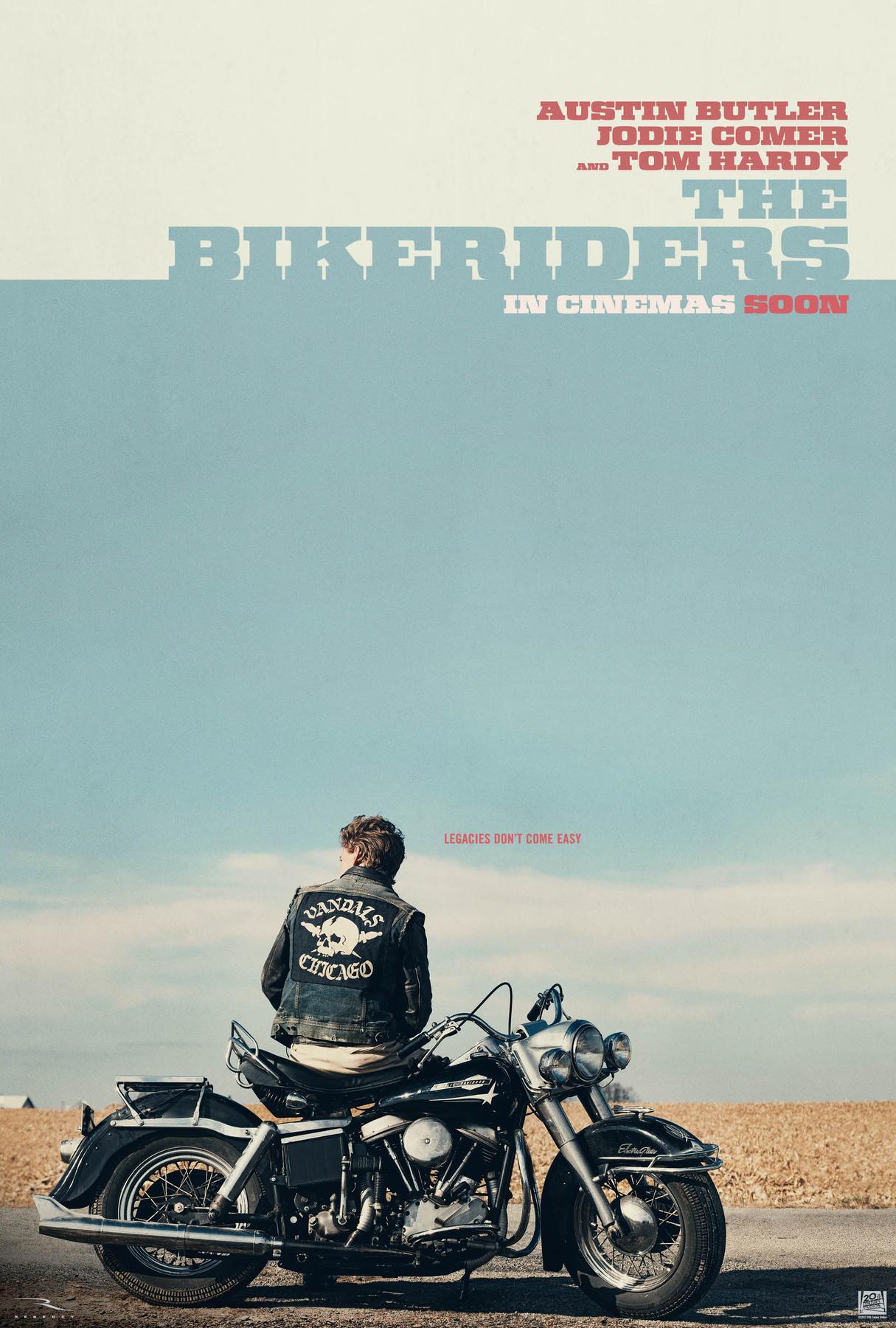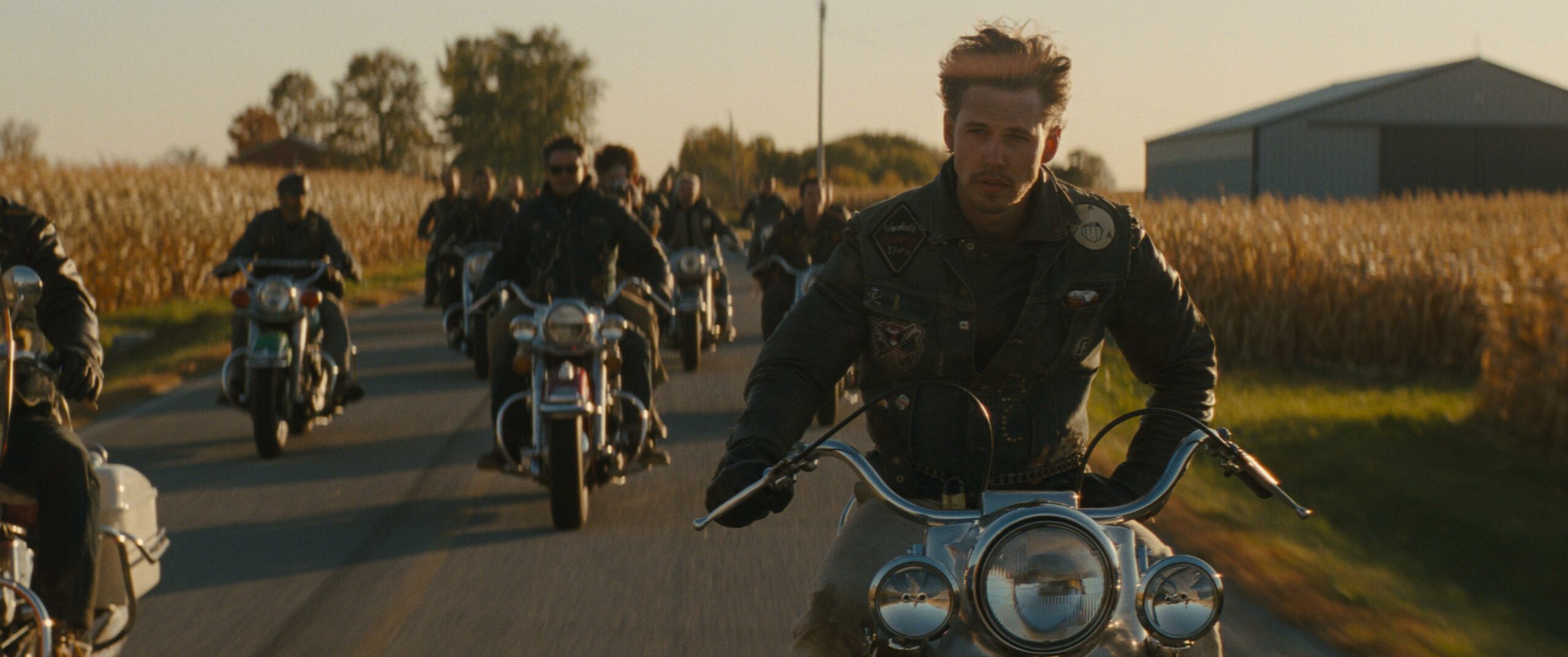

The Bikeriders is anthropological in origin. The film is based on a photo book (of the same name) and unpublished audio interviews created by Danny Lyons in the 1960s of a Chicago-based motorcycle club called the Outlaws in real life and the Vandals in the film. The film barely goes beyond anthropology itself. It’s like a live-action rendering of Lyons’ photos. The actors in the film embody the voices Lyons recorded. With the exception of one element, the film feels authentic to its time, place, and people through and through.
That exception is Austin Butler’s “Benny.” Benny feels like he walked off a movie screen, a la Tom Baxter in The Purple Rose of Cairo. He’s handsome and cool like James Dean or Marlon Brando. He’s above it all like Paul Newman. He’s the perfect ideal of everything the motorcycle club values – young and free and devoted entirely to what he loves, riding his motorcycle first and also his compatriots. He’s “holy.” Cathy, his girlfriend/wife, and Johnny, the leader of the group, want to possess him. He can barely be touched, much less held.
Realizing Benny this way is both true to the film’s source material—Benny’s face is never seen in Lyons’ photos; what we know about him is second-hand adoration in the interviews—and creates the film’s narrative tension: What will Benny do? Can anyone corral him? What would it mean about him, about them, about the things they value, if they could? Can their ideal survive? Is it possible? Should it be? Austin Butler is a Movie Star. Benny is too. He is everyone’s aspiration, inspiration, and dream.
Benny’s draw is inextricable from the violence that swirls around him as well. Does he create it? Some of it for sure sometimes. Does he direct it? Hmmm… Is it inescapable? Is it every justified? It is clearly destructive, so why is Benny’s volatility also so thrilling and alluring?
These are questions we also ask about violence in cinema in general. Writer/director Jeff Nichols has asked them in all of his films in one form or another. His primary preoccupation seems to be violence and the way it structures masculine society in particular but all of society really, since men tend to hold the power in the real world and exceptionally so in the parts of it in which Nichols sets his films. I don’t know that I’ve ever seen a film that was so obviously fictional but which feels so anthropological and which has this strong meta-commentary element running through it. It’s an odd mix, and most viewers won’t even notice it, I reckon. They’ll just think it’s a slightly inert but mostly compelling motorcycle movie full of beautiful and interesting people.
Does The Bikeriders offer any answers? Definitely not. Again, the primary mode here is anthropological. It’s about observation and reporting. It’s about rendering these people, this place, this time, and the dynamics between them as accurately as possible. Let the viewer reach what conclusions he or she will. Am I required then to offer some explanations in this review as an ideal viewer?
Don’t tell me what to do.
Just kidding, but I think I owed it to Benny to at least fein rebellion.
As I watched The Bikeriders I kept thinking about Beowulf and Tolkien’s men and orcs and Arthur and his knights. (I’ve been on a medieval literature kick lately.) Older than democracy, older even than monarchy, men have banded together to form and protect the tribe via violence when necessary, and violence is an option it seems to always be necessary. Heck even Peter carried a sword. It takes something stronger than a woman’s love to break that cycle. Humanity has rarely been brave enough to leave the pack and attempt something new. Dying for those you love is noble, but nobility is a lesser virtue. Humility and hope are better but they require faith in a Good that is greater than any we can muster up ourselves. The movie screen rarely provides them. Most often, at its best, the movie screen shows us the limits of our ideals, their inevitable inadequacies, casting a spell in order to disillusion us. The Bikeriders does that.
The Bikeriders is anthropological in origin. The film is based on a photo book (of the same name) and unpublished audio interviews created by Danny Lyons in the 1960s of a Chicago-based motorcycle club called the Outlaws in real life and the Vandals in the film. The film barely goes beyond anthropology itself. It’s like a live-action rendering of Lyons’ photos. The actors in the film embody the voices Lyons recorded. With the exception of one element, the film feels authentic to its time, place, and people through and through.
That exception is Austin Butler’s “Benny.” Benny feels like he walked off a movie screen, a la Tom Baxter in The Purple Rose of Cairo. He’s handsome and cool like James Dean or Marlon Brando. He’s above it all like Paul Newman. He’s the perfect ideal of everything the motorcycle club values – young and free and devoted entirely to what he loves, riding his motorcycle first and also his compatriots. He’s “holy.” Cathy, his girlfriend/wife, and Johnny, the leader of the group, want to possess him. He can barely be touched, much less held.
Realizing Benny this way is both true to the film’s source material—Benny’s face is never seen in Lyons’ photos; what we know about him is second-hand adoration in the interviews—and creates the film’s narrative tension: What will Benny do? Can anyone corral him? What would it mean about him, about them, about the things they value, if they could? Can their ideal survive? Is it possible? Should it be? Austin Butler is a Movie Star. Benny is too. He is everyone’s aspiration, inspiration, and dream.
Benny’s draw is inextricable from the violence that swirls around him as well. Does he create it? Some of it for sure sometimes. Does he direct it? Hmmm… Is it inescapable? Is it every justified? It is clearly destructive, so why is Benny’s volatility also so thrilling and alluring?
These are questions we also ask about violence in cinema in general. Writer/director Jeff Nichols has asked them in all of his films in one form or another. His primary preoccupation seems to be violence and the way it structures masculine society in particular but all of society really, since men tend to hold the power in the real world and exceptionally so in the parts of it in which Nichols sets his films. I don’t know that I’ve ever seen a film that was so obviously fictional but which feels so anthropological and which has this strong meta-commentary element running through it. It’s an odd mix, and most viewers won’t even notice it, I reckon. They’ll just think it’s a slightly inert but mostly compelling motorcycle movie full of beautiful and interesting people.
Does The Bikeriders offer any answers? Definitely not. Again, the primary mode here is anthropological. It’s about observation and reporting. It’s about rendering these people, this place, this time, and the dynamics between them as accurately as possible. Let the viewer reach what conclusions he or she will. Am I required then to offer some explanations in this review as an ideal viewer?
Don’t tell me what to do.
Just kidding, but I think I owed it to Benny to at least fein rebellion.
As I watched The Bikeriders I kept thinking about Beowulf and Tolkien’s men and orcs and Arthur and his knights. (I’ve been on a medieval literature kick lately.) Older than democracy, older even than monarchy, men have banded together to form and protect the tribe via violence when necessary, and violence is an option it seems to always be necessary. Heck even Peter carried a sword. It takes something stronger than a woman’s love to break that cycle. Humanity has rarely been brave enough to leave the pack and attempt something new. Dying for those you love is noble, but nobility is a lesser virtue. Humility and hope are better but they require faith in a Good that is greater than any we can muster up ourselves. The movie screen rarely provides them. Most often, at its best, the movie screen shows us the limits of our ideals, their inevitable inadequacies, casting a spell in order to disillusion us. The Bikeriders does that.

Elijah Davidson is Co-Director of Brehm Film and Senior Film Critic. Subscribe to Come & See, his weekly newsletter that guides you through the greatest films ever made, and find more of his work at elijahdavidson.com.
Fury Road’s staging and spectacle are exhilarating while the film’s pace is ultimately numbing. Furiosa’s saga is more poetic, using of surprising visual symbolism and editing rhythms to make the film more dynamic.