Movies should either be eighty-seven minutes or four hours long. Anything between those two times reveals a lack of discipline. Either tell the story with a sense of urgency that won’t allow anything that hints of the superfluous, or luxuriate in the artificial audio-visual world of the film. Give me speed, or give me space.
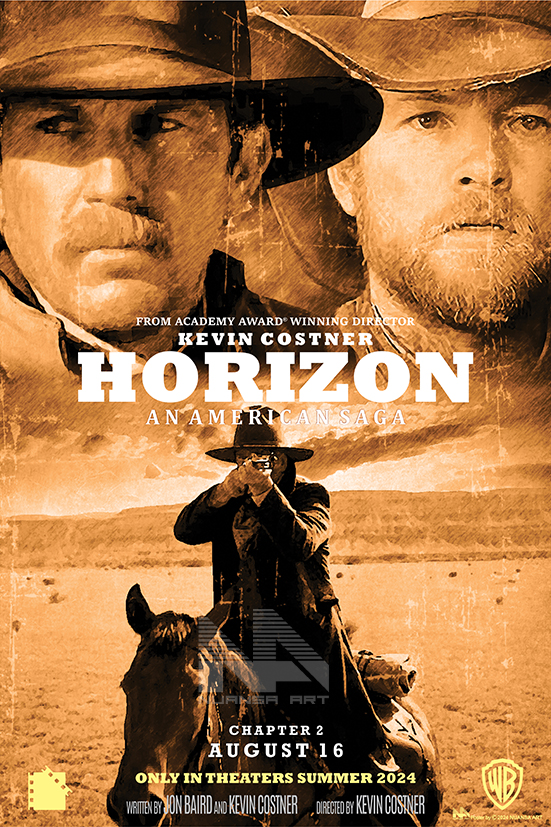
Kevin Costner’s Horizon: An American Saga isn’t eighty-seven minutes or four hours long. It’s just over three hours, but it’s also part one of a planned four-part film series that will be twelve hours long. It’s a story that benefits from space. This is about the American West after all, a sprawling expanse of space between sparse settlements, a truly remarkable space, space that still feels like space when you’re speeding through it at eighty miles per hour or even soaring 35000 feet over it. Imagine passing through it at the pace of a pair of oxen pulling a wagon, or on foot. A movie about that place needs room.
It has it. There are segments throughout the film that feel spacious, like Costner is reveling in the opportunity—maybe his last opportunity; there’s a “shoot your last shot” air to all of this—to create iconic “American” images, to commit them to the screen, as they used to say. That versions of these images have been created before in other Westerns, in paintings, in sculpture, in prose is besides the point. This is Costner’s go at it. These are his images. This is his film.
Which is to say, it’s not your film. The Western is a genre older than the movies but almost not. Westerns have been part of cinema since almost the beginning. The West was never what we see in the movies and read about in the dime store novels. It’s always been a myth. Over the years, at the movies, it’s been stood up like a lobby display, flipped sideways to show how thin that display is, sketched on by jokesters, folded up and stored in the back of a closet. But it’s never left us. Costner’s latest Western isn’t interested in being “revisionist” or “twisted” or even all that serious even when it’s hitting notes of high tragedy. It’s not even a “celebration of the Western as a genre.” It doesn’t seem pitched at any niche in particular. Everything seems to come pre-labeled and with disclaimers these days. Horizon isn’t. It just is what it is.
Could it be more deliberate? More pointed? Sure. Could it be less? I don’t think so. Even the pre-revisionism, classic Westerns had a point. Horizon doesn’t. It’s like, Here’s this thing. Do with it what you will.
I admire that. I like to sit with a myth every once and a while and not have it prejudged for me. I like to watch and consider why this myth was ever popular, why I played cowboys and Indians growing up, why my grandfather spent just about every day of the last twenty years of his life watching old Westerns on TV. I like to ponder whether or not we hold onto the myth or if they hold onto us. Why is this story worth revising? Why do we keep making Westerns? I think Horizon has these questions on its mind too. (By the way, the best Western I’ve watched in ages is The Harder They Fall. It’s on Netflix.)
In addition to being whatever Kevin Costner wants it to be, he also seems to want Horizon to be entertaining. So it never loses itself in its preoccupations. It stays with them just long enough to divulge the mind behind them at work. And then it moves on. It re-centers the plot in the way that broad audiences appear to like the plot to be kept in view. I think that’s why it’s broken into four segments and why this portion is three-ish hours long. It’s kind of like two eighty-seven minutes movies edited into each other. It’s also like part of a twelve hour movie that I have to watch in segments due to the demands of my life.
Part two of this saga was supposed to be in theaters in August. Now it’ll be released at some unspecified point in the future maybe in theaters, maybe via some streaming service. Apparently they think letting people watch part one at home will strengthen the interest in the rest of the story. I hope so. I’d like to see more of this.
Movies should either be eighty-seven minutes or four hours long. Anything between those two times reveals a lack of discipline. Either tell the story with a sense of urgency that won’t allow anything that hints of the superfluous, or luxuriate in the artificial audio-visual world of the film. Give me speed, or give me space.
Kevin Costner’s Horizon: An American Saga isn’t eighty-seven minutes or four hours long. It’s just over three hours, but it’s also part one of a planned four-part film series that will be twelve hours long. It’s a story that benefits from space. This is about the American West after all, a sprawling expanse of space between sparse settlements, a truly remarkable space, space that still feels like space when you’re speeding through it at eighty miles per hour or even soaring 35000 feet over it. Imagine passing through it at the pace of a pair of oxen pulling a wagon, or on foot. A movie about that place needs room.
It has it. There are segments throughout the film that feel spacious, like Costner is reveling in the opportunity—maybe his last opportunity; there’s a “shoot your last shot” air to all of this—to create iconic “American” images, to commit them to the screen, as they used to say. That versions of these images have been created before in other Westerns, in paintings, in sculpture, in prose is besides the point. This is Costner’s go at it. These are his images. This is his film.
Which is to say, it’s not your film. The Western is a genre older than the movies but almost not. Westerns have been part of cinema since almost the beginning. The West was never what we see in the movies and read about in the dime store novels. It’s always been a myth. Over the years, at the movies, it’s been stood up like a lobby display, flipped sideways to show how thin that display is, sketched on by jokesters, folded up and stored in the back of a closet. But it’s never left us. Costner’s latest Western isn’t interested in being “revisionist” or “twisted” or even all that serious even when it’s hitting notes of high tragedy. It’s not even a “celebration of the Western as a genre.” It doesn’t seem pitched at any niche in particular. Everything seems to come pre-labeled and with disclaimers these days. Horizon isn’t. It just is what it is.
Could it be more deliberate? More pointed? Sure. Could it be less? I don’t think so. Even the pre-revisionism, classic Westerns had a point. Horizon doesn’t. It’s like, Here’s this thing. Do with it what you will.
I admire that. I like to sit with a myth every once and a while and not have it prejudged for me. I like to watch and consider why this myth was ever popular, why I played cowboys and Indians growing up, why my grandfather spent just about every day of the last twenty years of his life watching old Westerns on TV. I like to ponder whether or not we hold onto the myth or if they hold onto us. Why is this story worth revising? Why do we keep making Westerns? I think Horizon has these questions on its mind too. (By the way, the best Western I’ve watched in ages is The Harder They Fall. It’s on Netflix.)
In addition to being whatever Kevin Costner wants it to be, he also seems to want Horizon to be entertaining. So it never loses itself in its preoccupations. It stays with them just long enough to divulge the mind behind them at work. And then it moves on. It re-centers the plot in the way that broad audiences appear to like the plot to be kept in view. I think that’s why it’s broken into four segments and why this portion is three-ish hours long. It’s kind of like two eighty-seven minutes movies edited into each other. It’s also like part of a twelve hour movie that I have to watch in segments due to the demands of my life.
Part two of this saga was supposed to be in theaters in August. Now it’ll be released at some unspecified point in the future maybe in theaters, maybe via some streaming service. Apparently they think letting people watch part one at home will strengthen the interest in the rest of the story. I hope so. I’d like to see more of this.

Elijah Davidson is Co-Director of Brehm Film and Senior Film Critic. Subscribe to Come & See, his weekly newsletter that guides you through the greatest films ever made, and find more of his work at elijahdavidson.com.
I don’t know that I’ve ever seen a film that was so obviously fictional but which feels so anthropological and which has this strong meta-commentary element running through it.