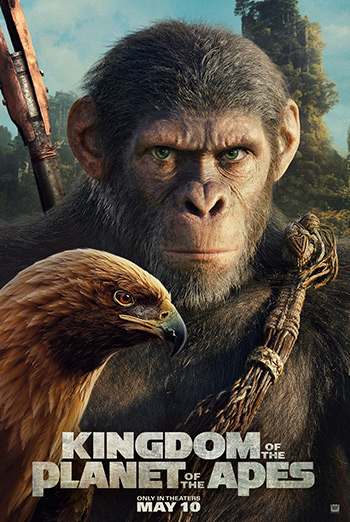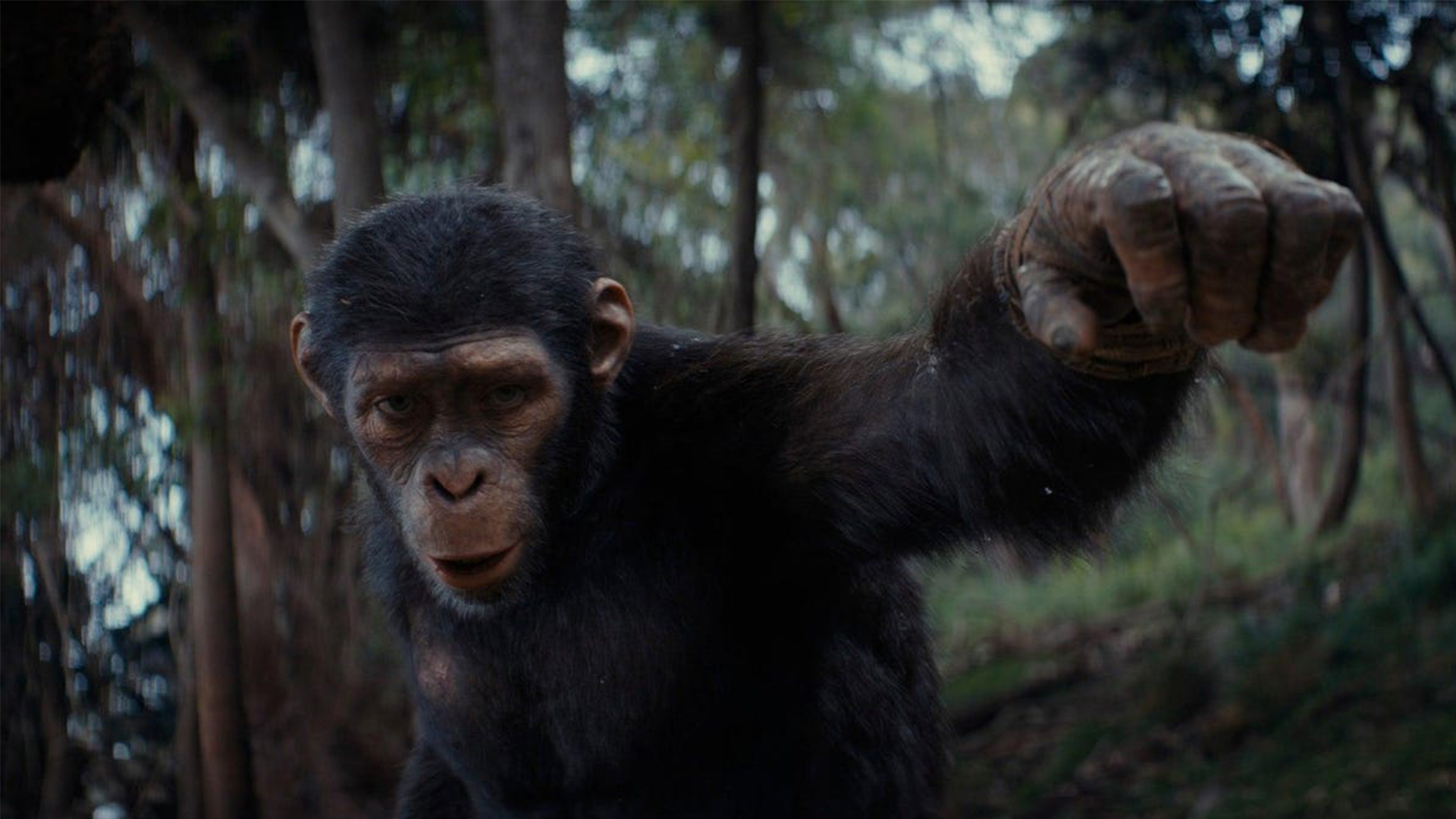

Kingdom of the Planet of the Apes – not bad! It is basic, predictable, hero’s journey stuff with the high-quality motion capture animation we’ve come to expect from these recent Apes films (really, highest quality special effects for its time has always been a hallmark of an Apes film in every decade).The characters aren’t as compelling as the previous three films’ chief chimp, Andy Serkis’ Caesar, but maybe it’s not fair to compare other performers to Serkis and other mo-cap characters to ones performed by Serkis. He’s the best; Caesar was as complex a character as we’ve seen in our blockbusters in the last two decades. But the characters in Kingdom aren’t bad. The movie isn’t bad. It’s fine.
Now that we got that out of the way, let’s consider the little part of the movie that is interesting in the way the best Apes movies are interesting. The Apes movies are at their best when they show us something akin to our human world but reflected through the series’ monkey-shaped mirror. In this installment, that simian similarity has to do with Caesar’s legacy. This film is set “many generations” after the death of Caesar. He has become a religious figure amongst the apes. His teachings have become like sacred texts. Apes do things “in the name of Caesar.”
But there is disagreement over what Caesar’s teachings mean and how they should be applied to the apes’ present circumstances. Some apes, like our protagonist, Noah, don’t really even know about Caesar at all. These uninitiated apes get caught between conflicting interpretations of Caesar’s life and teachings… or at least they could if the movie spent a little more effort to develop this tension in the story. It’s constantly present but not emphasized, and it loses out to basic action beats as the story goes along. We’re not bound by the demands of necessary box office returns here though, so we can give it a little more attention.
There isn’t a scene in Kingdom of the Planet of the Apes where two apes engage in an apologetic argument about what Caesar “really meant” and what Caesar’s teaching “mean for apes today.” The argument plays out in the action, sorta.
Those sorts of arguments are essential to our life today, not about Caesar but about Jesus, of course. We are currently engaged in a giant argument about who Jesus is and what his teachings require of us now. The argument plays out in our politics and in our pocket books. It should be a more present subject in our church board meetings and trustee deliberations. For those of us who work for Christian organizations, it ought to be the basic substance of our deliberations and decision making process. We rarely talk about it openly and directly though, huh?
How about this? I’ll do what Kingdom of the Planet of the Apes doesn’t do – I’ll state as clearly as I can who I believe Jesus is and what I think his life and teachings require of us today. I know you can’t reply to me any more than I can reply to the movie screen. But you’ll either agree with what I write or disagree with it. Either way, you’ll be prompted to consider your own beliefs. I think statements of faith are at their best when they are like a free-standing wall we all get to bounce our own beliefs against together (not a wall we have to climb in order to be admitted to a club). Here we go:
I believe that Jesus is the son of God. He lived about two thousand years ago. He was executed via a conspiracy between the religious authorities and the state. But he didn’t stay dead – he rose again. Then before he ascended bodily into eternity—and that’s something I truly do not understand—he charged his disciples to carry his message out into the world.
What’s that message?
The kingdom of the apes, um, I mean heaven is here now. It doesn’t require any kind of political, military, or cultural victory. It is known whenever people love one another the way Jesus loved others – sacrificially, bravely, always in a way that challenged the hard lines of “in” and “out” drawn by those with power to preserve, love that loves unto death if need be. I fail at that kind of love daily, but God’s mercy is wider than I can imagine. Jesus showed me that. So in faith I will keep trying to love and I will trust God’s love to override all in the end. I believe it’s okay if we disagree on these things, that the truth isn’t dependent on our understanding or affirmation of it. You might disagree with me about that. I would again point to God’s mercy. You might point to God’s lordship. We’d both be correct, I believe.
And by now you’re probably wondering what happened to the review of Kingdom of the Planet of the Apes you thought you were going to be reading. These Apes films have always been about more than good makeup. That’s what makes the series great. I hope the future installments are more interested in their themes than this one is, but I’ll also take any opportunity I can get to talk about Jesus.
Kingdom of the Planet of the Apes – not bad! It is basic, predictable, hero’s journey stuff with the high-quality motion capture animation we’ve come to expect from these recent Apes films (really, highest quality special effects for its time has always been a hallmark of an Apes film in every decade).The characters aren’t as compelling as the previous three films’ chief chimp, Andy Serkis’ Caesar, but maybe it’s not fair to compare other performers to Serkis and other mo-cap characters to ones performed by Serkis. He’s the best; Caesar was as complex a character as we’ve seen in our blockbusters in the last two decades. But the characters in Kingdom aren’t bad. The movie isn’t bad. It’s fine.
Now that we got that out of the way, let’s consider the little part of the movie that is interesting in the way the best Apes movies are interesting. The Apes movies are at their best when they show us something akin to our human world but reflected through the series’ monkey-shaped mirror. In this installment, that simian similarity has to do with Caesar’s legacy. This film is set “many generations” after the death of Caesar. He has become a religious figure amongst the apes. His teachings have become like sacred texts. Apes do things “in the name of Caesar.”
But there is disagreement over what Caesar’s teachings mean and how they should be applied to the apes’ present circumstances. Some apes, like our protagonist, Noah, don’t really even know about Caesar at all. These uninitiated apes get caught between conflicting interpretations of Caesar’s life and teachings… or at least they could if the movie spent a little more effort to develop this tension in the story. It’s constantly present but not emphasized, and it loses out to basic action beats as the story goes along. We’re not bound by the demands of necessary box office returns here though, so we can give it a little more attention.
There isn’t a scene in Kingdom of the Planet of the Apes where two apes engage in an apologetic argument about what Caesar “really meant” and what Caesar’s teaching “mean for apes today.” The argument plays out in the action, sorta.
Those sorts of arguments are essential to our life today, not about Caesar but about Jesus, of course. We are currently engaged in a giant argument about who Jesus is and what his teachings require of us now. The argument plays out in our politics and in our pocket books. It should be a more present subject in our church board meetings and trustee deliberations. For those of us who work for Christian organizations, it ought to be the basic substance of our deliberations and decision making process. We rarely talk about it openly and directly though, huh?
How about this? I’ll do what Kingdom of the Planet of the Apes doesn’t do – I’ll state as clearly as I can who I believe Jesus is and what I think his life and teachings require of us today. I know you can’t reply to me any more than I can reply to the movie screen. But you’ll either agree with what I write or disagree with it. Either way, you’ll be prompted to consider your own beliefs. I think statements of faith are at their best when they are like a free-standing wall we all get to bounce our own beliefs against together (not a wall we have to climb in order to be admitted to a club). Here we go:
I believe that Jesus is the son of God. He lived about two thousand years ago. He was executed via a conspiracy between the religious authorities and the state. But he didn’t stay dead – he rose again. Then before he ascended bodily into eternity—and that’s something I truly do not understand—he charged his disciples to carry his message out into the world.
What’s that message?
The kingdom of the apes, um, I mean heaven is here now. It doesn’t require any kind of political, military, or cultural victory. It is known whenever people love one another the way Jesus loved others – sacrificially, bravely, always in a way that challenged the hard lines of “in” and “out” drawn by those with power to preserve, love that loves unto death if need be. I fail at that kind of love daily, but God’s mercy is wider than I can imagine. Jesus showed me that. So in faith I will keep trying to love and I will trust God’s love to override all in the end. I believe it’s okay if we disagree on these things, that the truth isn’t dependent on our understanding or affirmation of it. You might disagree with me about that. I would again point to God’s mercy. You might point to God’s lordship. We’d both be correct, I believe.
And by now you’re probably wondering what happened to the review of Kingdom of the Planet of the Apes you thought you were going to be reading. These Apes films have always been about more than good makeup. That’s what makes the series great. I hope the future installments are more interested in their themes than this one is, but I’ll also take any opportunity I can get to talk about Jesus.

Elijah Davidson is Co-Director of Brehm Film and Senior Film Critic. Subscribe to Come & See, his weekly newsletter that guides you through the greatest films ever made, and find more of his work at elijahdavidson.com.
Challengers gives us the sport as an allegory for love, an intense physical, emotional, and psychological relationship between two people so riddled with the trappings of our economic reality, genuine connection becomes almost impossible.