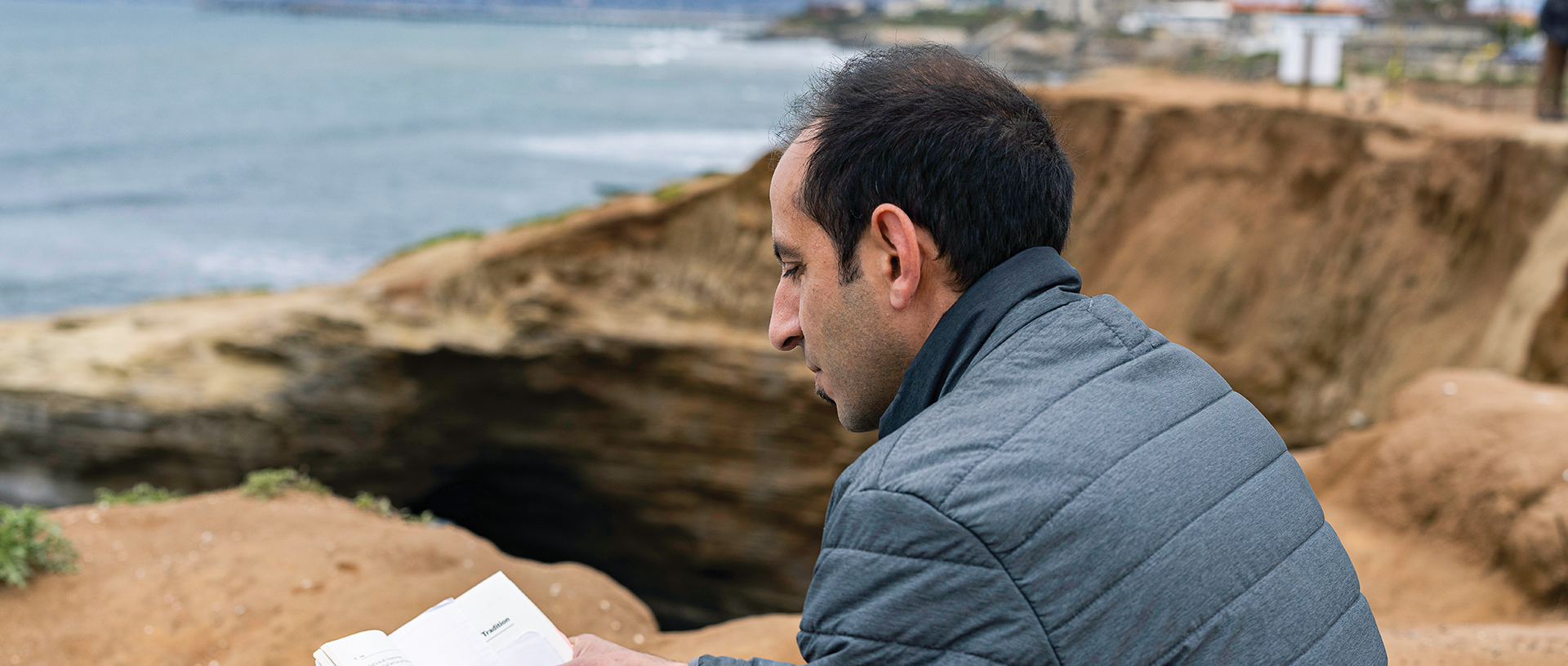

“I’m not meant to stand in a pulpit,” says Rafee Jajou (current MAC student). “I’m meant to sit right beside people and give them hope.”
A member of the inaugural class of Fuller’s MA in Chaplaincy program, Rafee opens up about his ministry as both a hospital and hospice chaplain, as well as the story of how he was called to chaplaincy after his start as a congregational pastor.
Rafee’s work as a chaplain can place him in a variety of contexts. For hospice care, Rafee conducts visits around the county, to both homes and long-term care facilities, where he ministers to people with serious or terminal conditions. Here, he might journey with patients and their families for months-long seasons—building relationships and rapport and establishing routines of coping and comfort. Chaplaincy at the hospital is faster-paced, with multiple variables at play. The hospital network he’s connected with includes ERs and ICUs, a women’s hospital, a neo-natal ICU, and a behavioral health hospital, and his work requires triaging and urgency in compressed periods of time. The diversity of ages, ethnicities, cultures, religions, and languages—not to mention medical conditions—with this mix of patients makes for rapidly changing and often shifting contexts of care. In all of it, however, Rafee has the same calling: to help people find hope in their hopelessness.
“I’m not here to preach. I’m not here to convert anyone,” he says, explaining a chaplain’s role. His task is spiritual care. He clarifies: “Spiritual care is not religious care. Religious care is a subset of spiritual care. But spiritual care includes meaning and purpose in life, values and beliefs. It’s a general term on purpose because everyone’s spiritual life, across the world, can be very different.” Beyond religious rituals and faith practices, Rafee says what is spiritual for somebody may range from music, or art, or literature, to whatever passions one has that feed their body and mind, to the relationships that person has and their connections to society.
In hospice or hospital chaplaincy, Rafee seeks to know what matters to a person—what gives a person purpose and meaning. From that place of understanding, he might walk with them through the struggle or situation they’re in. He doesn’t come in with a preconceived plan to discuss religion or faith; instead, he says, “I have to start with where a person is at. I’m looking to them to tell me where their spiritual sources of strength are in their life.”
Rafee came to chaplaincy by way of pastoral ministry. “I was called to pastoral ministry at the age of 19,” he says. He’d gone straight from earning his BA in biblical studies at a Christian university to returning to his home church to serve as an associate pastor. He pastored there for five years until the church had to shut its doors—a season that left him with both hurt and a lack of direction about what was next. “I felt lost,” he says. He sensed no tug toward applying for roles at unfamiliar churches, since he had only felt particularly called to his home church community. So, as he tells it, “I went into the business world to pay the bills.”

Jerome Blanco (MDiv ’16) is the editor in chief of FULLER magazine.

Karley Carrillo is a creative producer for Christian Assembly Church in Los Angeles and a freelance photographer. See more of her work at itsmekarley.com.
“I’m not meant to stand in a pulpit,” says Rafee Jajou (current MAC student). “I’m meant to sit right beside people and give them hope.”
A member of the inaugural class of Fuller’s MA in Chaplaincy program, Rafee opens up about his ministry as both a hospital and hospice chaplain, as well as the story of how he was called to chaplaincy after his start as a congregational pastor.
Rafee’s work as a chaplain can place him in a variety of contexts. For hospice care, Rafee conducts visits around the county, to both homes and long-term care facilities, where he ministers to people with serious or terminal conditions. Here, he might journey with patients and their families for months-long seasons—building relationships and rapport and establishing routines of coping and comfort. Chaplaincy at the hospital is faster-paced, with multiple variables at play. The hospital network he’s connected with includes ERs and ICUs, a women’s hospital, a neo-natal ICU, and a behavioral health hospital, and his work requires triaging and urgency in compressed periods of time. The diversity of ages, ethnicities, cultures, religions, and languages—not to mention medical conditions—with this mix of patients makes for rapidly changing and often shifting contexts of care. In all of it, however, Rafee has the same calling: to help people find hope in their hopelessness.
“I’m not here to preach. I’m not here to convert anyone,” he says, explaining a chaplain’s role. His task is spiritual care. He clarifies: “Spiritual care is not religious care. Religious care is a subset of spiritual care. But spiritual care includes meaning and purpose in life, values and beliefs. It’s a general term on purpose because everyone’s spiritual life, across the world, can be very different.” Beyond religious rituals and faith practices, Rafee says what is spiritual for somebody may range from music, or art, or literature, to whatever passions one has that feed their body and mind, to the relationships that person has and their connections to society.
In hospice or hospital chaplaincy, Rafee seeks to know what matters to a person—what gives a person purpose and meaning. From that place of understanding, he might walk with them through the struggle or situation they’re in. He doesn’t come in with a preconceived plan to discuss religion or faith; instead, he says, “I have to start with where a person is at. I’m looking to them to tell me where their spiritual sources of strength are in their life.”
Rafee came to chaplaincy by way of pastoral ministry. “I was called to pastoral ministry at the age of 19,” he says. He’d gone straight from earning his BA in biblical studies at a Christian university to returning to his home church to serve as an associate pastor. He pastored there for five years until the church had to shut its doors—a season that left him with both hurt and a lack of direction about what was next. “I felt lost,” he says. He sensed no tug toward applying for roles at unfamiliar churches, since he had only felt particularly called to his home church community. So, as he tells it, “I went into the business world to pay the bills.”
Jerome Blanco (MDiv ’16) is the editor in chief of FULLER magazine.
Karley Carrillo is a creative producer for Christian Assembly Church in Los Angeles and a freelance photographer. See more of her work at itsmekarley.com.

But three years in, Rafee found himself in what he calls a “spiritual desert.” He says, “I knew that the work I was called to do was spiritual; I was called to help people on their journey with Jesus.” So, he opened himself up again to where God would lead him. And God opened doors.
Rafee and a friend began to plant a church. At the same time, Rafee found part-time work as a chaplaincy intern at a local hospital—in a Clinical Pastoral Education (CPE) program. While he left the program before finishing, he went on to pastor the church plant for the next seven years.
When the church eventually closed, it was a much healthier process than the previous time and happened on his own terms. Still, those years set important groundwork for what would come next. In that time, Rafee had grown to recognize that his gifts and strengths lent themselves to personal and one-on-one spiritual care. God was guiding him to become a chaplain.
A friend of his—another pastor-turned-chaplain and Fuller alum—got in touch to tell Rafee about a corporate chaplaincy opening. The friend asked, “Can you provide a safe place for people in the company during their crisis moments?” Rafee knew he could. He did so for five years, providing a ministry of presence for employees in their different seasons of life, until that fruitful season came to its end and he stepped into hospice and hospital chaplaincy (while also finally completing the CPE program he’d left years prior).
Over these many different seasons of ministry, Rafee has deepened his understanding of what it means to be an effective chaplain, especially when it comes to finding common ground on which to stand with a person through their most difficult moments. Rafee says, “My view of God’s work in the world and the way he’s working used to be limited to just Jesus in the church, but in providing spiritual care in a diverse context through chaplaincy, I realized God’s work in the world is beyond the church. It’s already happening. Beyond any ‘Christian’ context, God is already there.” He says recognizing this is a key to “bringing chaplains into a place of connecting with people.”
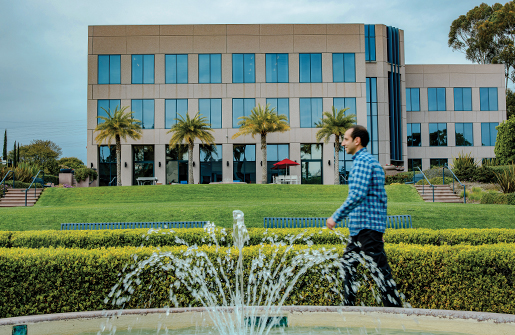
Rafee explains that there are two main things that people who are suffering need: “They need to know they’re not alone, and they need to know that they can still love and be loved in their suffering.” Here is where a chaplain brings a ministry
of presence.
“People ask big questions,” he says. “‘Why, God? Why me?’” For patients nearing a hundred, who have outlived spouses and even their children by decades, a big question is “Why am I still here?” Rafee doesn’t have answers and doesn’t pretend to have answers. But, he says, “Chaplaincy is not about answers but about vocalizing the questions.” He’s a listening ear, a sincere presence, a companion in the suffering.
“I listen to what matters to them,” he says, reiterating that what matters to each person may or may not be religious, but are always deeply spiritual. “Listening is a key practice of chaplaincy. We’re listening for where the pain is. We’re listening for where the joy is. We’re listening for where the fear is. Those are spiritual things. And in the act of listening, we’re saying ‘I’m showing up because you matter,’ and that alone can be healing. In listening, we’re demonstrating Jesus.”
Rafee shares about a hospice patient he visits who is likely to die in the coming months. The patient, a former professor of poetry, is isolated from community and without family. “What helps him calm down and what helps him feel connection,” he says, “is me reciting poetry with him for about a half hour every week. And letting him talk about it, and letting him process with me what the poem is about. His eyesight is failing, so I read for him.”
Music can be another powerful point of connection, especially for his patients with dementia or Alzheimer’s, who have difficulty in conversation. Music forms a bridge: “For some, the only music they remember is from the 1950s. I play it on my smartphone, and in that moment, we’re together, and they are feeling more connected to themselves.” Rafee likens this to what reciting liturgies can be like with his Catholic patients. “It’s whatever helps them get grounded, gets their minds off their suffering, fear, and confusion. What helps them get past the next hour.”
This isn’t always easy. Many patients can be resistant to opening up to a stranger or feel as if their spiritual needs are being met through other means. This shouldn’t feel personal to the chaplain, Rafee says, because in the end, it’s the patient’s care that matters. Still other times, the connection can become surprisingly deep, and the challenge is remaining centered on the patient and regulating oneself, while maintaining the empathy and compassion that’s so important to this ministry.
Rafee recalls visiting a dying patient, a father of six children, in the hospital. The doctors couldn’t release him because of the instability of his condition, so he couldn’t return home and would die in the hospital. Rafee led a prayer for the family who had gathered in the room. He says, “I saw myself as a father, and I saw the love being shared in that room. I began to cry with the family, and as I was trying to continue praying and speaking the blessing, I had to manage my own emotions in the middle of that.”
Outside of the room, it’s essential for chaplains to care for themselves. “Compassion fatigue is real,” Rafee admits. “My practice is to not isolate or hold it all in. It’s necessary to release the emotions of stress or grief.” For him, this looks like exercise, prayer, or being outdoors. Being in a supportive community that strengthens one another is important too—he notes the unique gift his MA in Chaplaincy cohort has been. He says that, in the difficult work of chaplaincy, he needs to surround himself with loved ones and with beauty. “There’s a world of life and joy that’s happening all around,” he says. Keeping that balance is essential in a vocation steeped in suffering: “Learning to live with those two things—it’s not all dark and sad, and it’s not all beautiful and perfect either. I have to be in those two worlds.”
That’s the call for a chaplain like Rafee: to carry hope into the spaces where there seems to be no hope. And every day, he knows this requires complete reliance on the Spirit. There’s a prayer he has for himself, as he ministers everyday alongside those suffering: “God, give me the grace, the love, the compassion, the peace, to be there for someone who needs it.”
Mary Glenn and Jaclyn Williams, co-chairs for Fuller’s MA in Chaplaincy, describe the healing, collaborative, and transformative ministry of chaplaincy and its significance in today’s world.