Illustration by Charity Ellis
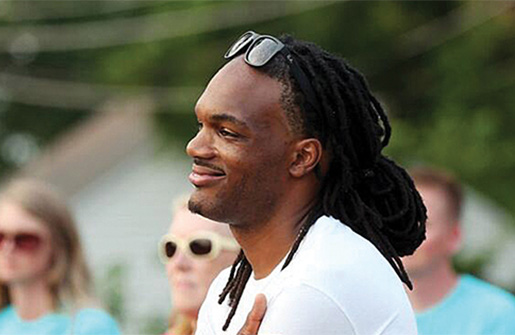
Rev. Earl Smith (MAGL ’24) currently serves as chaplain for the San Francisco 49ers and the Golden State Warriors. A former chaplain at San Quentin Prison where he worked for nearly 24 years, he was named National Correctional Chaplain of the Year in 2000. Smith has appeared on HBO, CNN, The 700 Club, Trinity Broadcasting, and the Discovery Channel, has been featured in Newsweek and Time, and is the author of Death Row Chaplain: Unbelievable True Stories from America’s Most Notorious Prison. He was born and raised in Stockton, California, where he lives today with his wife, Angel.
Chantelle Gibbs-Tarca: At age 27, you answered the call to chaplaincy and became the youngest person ever hired by the California Department of Corrections to chaplain at San Quentin Prison. You detailed your time working at San Quentin in your book Death Row Chaplain, but let’s rewind—what was going on in your life when that call came? How did that happen?
Earl Smith: I’d been a gang member since I was eight years old. The first time I was arrested, I was eight. My life involved drug dealing, gangs, and other things. At 19, I was shot six times. In the hospital, the doctor said I was going to die because I’d been shot all over my face and neck. My father came and told the doctor, “You do what you do best. I’m going to do what I do best.” And he went and prayed. I was left in that room by myself, and a voice said, “You’re not going to die. You’re going to be a chaplain in San Quentin.”
After a lot of God interventions, I later joined a service club, and a guy there said to me, “You said you wanted to be a chaplain. There’s an opening at San Quentin.” After applying, I got a letter from the state personnel board saying, “Dear Reverend Smith, we’re sorry to inform you that you don’t meet the minimum qualifications.” I balled it up, threw it away, and then heard the Spirit say, “Call and ask why.” When I called to ask about it, there was a pause on the line, and then, “Reverend Smith, we’re very sorry; we sent you the wrong letter!” I actually was qualified. I went in for an interview and eventually got the job.
San Quentin was the most notorious prison in California. When I started to work there, we were locked down 13 of the first 16 months. The day I interviewed, two people were killed. Guys weren’t coming to chapel. I prayed, “God, if you really want me here, I know you don’t want me to just be in a building because I’m not used to being in buildings.” My understanding of chaplaincy at that point was nil, and I didn’t even have a very good understanding of church. But he knew the ministry I needed to be a part of was not to be an organized, structured church setting—I needed to move around. I also needed to be able to communicate with guys like me. They were guys that were in gangs and guys that had done a lot of things wrong. I wanted to be able to say, “But also, you can do some things right.” Some of my old gang members were there, including one of my best friends. And I was able to encourage them.
I was representing the Department of Corrections and the State Advisory Committee on Institutional Religion; every state agency that had a chaplaincy department had a representative there. So I was able to see some things. Twenty-four years into being there, I got injured at the prison, so they retired me. But retirement, for me, just meant that I’d start at a different assignment in prison. So I started teaching at eight different prisons. I started writing programs and saw how I could duplicate what we were doing at San Quentin.
San Quentin had gone from five people in the chapel to 380. It went from maybe 8 to 10 volunteers to over 200-person churches. How do you duplicate that? Then people wanted to work there because of the name it held. What a lot of chaplains didn’t understand was the need to give the program to the inmates. I trained chaplains to create calendars of events for a full year and to let the inmates help create it. If you give them ownership, you’re going to be successful because they’re successful. In chaplaincy, you have to remove yourself from the process in order to make sure that you see God in the process. There has to be that separation.
CGT: Coming from so many years of ministry in prison chaplaincy, how did your entry into sports chaplaincy come about? What does that area of ministry look like?
ES: While working at the prison, I was asked by Pat Richie, chaplain for the San Jose Sharks, the Giants, and the 49ers, if I would help do chapel services for his guys. About a year into it, Dan Finnane, the owner of the Golden State Warriors, called me saying, “I’d like to know if you would be interested in doing chaplaincy for the Warriors.” I said, “No. In fact, if you don’t really tell me who this is, I’m gonna hang up.” I’m telling the owner of the team this, and he’s laughing, and my wife is asking, “What is going on?” He says, “I really am the owner of the team. I heard you don’t like basketball. But will you at least come and pray with our team?” My wife loves basketball, so once we got there and met the team, she said to me, “You will be the chaplain for the Warriors.” And yes, I paid attention.
Ministry with sports teams is interesting because, let’s say, with the Warriors, there are 41 home games. My ministry for a team is for the support staff in the arena as well. I give out my programs and handouts to police officers, to referees, to all the ushers. I shake each of their hands, thank them for being there, and let them know I’m praying for them and their families. When you’re there, even to the press, you’re seen as the pastor of that building. You can never lose sight of the fact that you’re pastoring a building where maybe a lot of the people there don’t have a pastor.
CGT: In your decades-long journey in ministry, both in the prison and sports arena, are there any stories you can share when you were greatly encouraged by what you witnessed?
ES: One time at the prison, I asked the warden if we could host a banquet. Then I went to the gang leaders and said, “Hey guys, if I can just get 30 days where nobody is killed, the wardens will let us have a banquet. You can invite your family, and we’ll have a real meal. They’ll be able to come to chapel; they’ll be able to see the ministry. But you have to do it. I can’t do it.” We had a truce, and we were able to have a really great meal with family members who came inside the walls of the prison. Bubba Paris from the San Francisco 49ers came to speak, and Walter Hawkins and the Love Center Choir did the music. And that set a different tone of what ministry could be in a prison. I never thought that prison ministry should be confined within the walls. I always thought that the community should have an active role and involvement in prison ministry because guys are going to get out. And if we start to introduce them to the community while they’re in prison, they’re more prone to be successful upon release.
Success with inmates is how they process their today. Can they transfer anything that they’ve heard or felt or seen into a better tomorrow? At San Quentin, success for me was starting a baseball team. We took guys who were not involved with chapel, built the baseball field, and played baseball. Sometimes we allow religiosity to get in the way of what God defines as success. So, when I say “success,” I mean seeing that baseball team made up of guys that were not part of the chapel, that were Black and Hispanic—unheard of for inmates from different ethnic groups to do anything together—all play together. Those guys decided we could do something together for the sake of playing this game called baseball. Baseball is the best game in the world for inmates because you can be a failure seven times and be a success three times. And if you bat .300, you can play the game forever. So it teaches you not to be focused on your failures and to enjoy your successes. And for prisoners, what better thing to deal with in preparation for going home than to start to say, “Let’s focus more on what our successes are and not focus as much on our failures”? It was success to me because we brought together people who would normally not want to be affiliated with each other. If I can get prisoners from different gangs together for the common good of something, how much more should the church do the same? Success wasn’t in the chapel. It was on that field.

Chantelle Gibbs-Tarca is content producer and managing editor of FULLER magazine.

Rev. Earl Smith (MAGL ’24) currently serves as chaplain for the San Francisco 49ers and the Golden State Warriors.
Rev. Earl Smith (MAGL ’24) currently serves as chaplain for the San Francisco 49ers and the Golden State Warriors. A former chaplain at San Quentin Prison where he worked for nearly 24 years, he was named National Correctional Chaplain of the Year in 2000. Smith has appeared on HBO, CNN, The 700 Club, Trinity Broadcasting, and the Discovery Channel, has been featured in Newsweek and Time, and is the author of Death Row Chaplain: Unbelievable True Stories from America’s Most Notorious Prison. He was born and raised in Stockton, California, where he lives today with his wife, Angel.
Chantelle Gibbs-Tarca: At age 27, you answered the call to chaplaincy and became the youngest person ever hired by the California Department of Corrections to chaplain at San Quentin Prison. You detailed your time working at San Quentin in your book Death Row Chaplain, but let’s rewind—what was going on in your life when that call came? How did that happen?
Earl Smith: I’d been a gang member since I was eight years old. The first time I was arrested, I was eight. My life involved drug dealing, gangs, and other things. At 19, I was shot six times. In the hospital, the doctor said I was going to die because I’d been shot all over my face and neck. My father came and told the doctor, “You do what you do best. I’m going to do what I do best.” And he went and prayed. I was left in that room by myself, and a voice said, “You’re not going to die. You’re going to be a chaplain in San Quentin.”
After a lot of God interventions, I later joined a service club, and a guy there said to me, “You said you wanted to be a chaplain. There’s an opening at San Quentin.” After applying, I got a letter from the state personnel board saying, “Dear Reverend Smith, we’re sorry to inform you that you don’t meet the minimum qualifications.” I balled it up, threw it away, and then heard the Spirit say, “Call and ask why.” When I called to ask about it, there was a pause on the line, and then, “Reverend Smith, we’re very sorry; we sent you the wrong letter!” I actually was qualified. I went in for an interview and eventually got the job.
San Quentin was the most notorious prison in California. When I started to work there, we were locked down 13 of the first 16 months. The day I interviewed, two people were killed. Guys weren’t coming to chapel. I prayed, “God, if you really want me here, I know you don’t want me to just be in a building because I’m not used to being in buildings.” My understanding of chaplaincy at that point was nil, and I didn’t even have a very good understanding of church. But he knew the ministry I needed to be a part of was not to be an organized, structured church setting—I needed to move around. I also needed to be able to communicate with guys like me. They were guys that were in gangs and guys that had done a lot of things wrong. I wanted to be able to say, “But also, you can do some things right.” Some of my old gang members were there, including one of my best friends. And I was able to encourage them.
I was representing the Department of Corrections and the State Advisory Committee on Institutional Religion; every state agency that had a chaplaincy department had a representative there. So I was able to see some things. Twenty-four years into being there, I got injured at the prison, so they retired me. But retirement, for me, just meant that I’d start at a different assignment in prison. So I started teaching at eight different prisons. I started writing programs and saw how I could duplicate what we were doing at San Quentin.
San Quentin had gone from five people in the chapel to 380. It went from maybe 8 to 10 volunteers to over 200-person churches. How do you duplicate that? Then people wanted to work there because of the name it held. What a lot of chaplains didn’t understand was the need to give the program to the inmates. I trained chaplains to create calendars of events for a full year and to let the inmates help create it. If you give them ownership, you’re going to be successful because they’re successful. In chaplaincy, you have to remove yourself from the process in order to make sure that you see God in the process. There has to be that separation.
CGT: Coming from so many years of ministry in prison chaplaincy, how did your entry into sports chaplaincy come about? What does that area of ministry look like?
ES: While working at the prison, I was asked by Pat Richie, chaplain for the San Jose Sharks, the Giants, and the 49ers, if I would help do chapel services for his guys. About a year into it, Dan Finnane, the owner of the Golden State Warriors, called me saying, “I’d like to know if you would be interested in doing chaplaincy for the Warriors.” I said, “No. In fact, if you don’t really tell me who this is, I’m gonna hang up.” I’m telling the owner of the team this, and he’s laughing, and my wife is asking, “What is going on?” He says, “I really am the owner of the team. I heard you don’t like basketball. But will you at least come and pray with our team?” My wife loves basketball, so once we got there and met the team, she said to me, “You will be the chaplain for the Warriors.” And yes, I paid attention.
Ministry with sports teams is interesting because, let’s say, with the Warriors, there are 41 home games. My ministry for a team is for the support staff in the arena as well. I give out my programs and handouts to police officers, to referees, to all the ushers. I shake each of their hands, thank them for being there, and let them know I’m praying for them and their families. When you’re there, even to the press, you’re seen as the pastor of that building. You can never lose sight of the fact that you’re pastoring a building where maybe a lot of the people there don’t have a pastor.
CGT: In your decades-long journey in ministry, both in the prison and sports arena, are there any stories you can share when you were greatly encouraged by what you witnessed?
ES: One time at the prison, I asked the warden if we could host a banquet. Then I went to the gang leaders and said, “Hey guys, if I can just get 30 days where nobody is killed, the wardens will let us have a banquet. You can invite your family, and we’ll have a real meal. They’ll be able to come to chapel; they’ll be able to see the ministry. But you have to do it. I can’t do it.” We had a truce, and we were able to have a really great meal with family members who came inside the walls of the prison. Bubba Paris from the San Francisco 49ers came to speak, and Walter Hawkins and the Love Center Choir did the music. And that set a different tone of what ministry could be in a prison. I never thought that prison ministry should be confined within the walls. I always thought that the community should have an active role and involvement in prison ministry because guys are going to get out. And if we start to introduce them to the community while they’re in prison, they’re more prone to be successful upon release.
Success with inmates is how they process their today. Can they transfer anything that they’ve heard or felt or seen into a better tomorrow? At San Quentin, success for me was starting a baseball team. We took guys who were not involved with chapel, built the baseball field, and played baseball. Sometimes we allow religiosity to get in the way of what God defines as success. So, when I say “success,” I mean seeing that baseball team made up of guys that were not part of the chapel, that were Black and Hispanic—unheard of for inmates from different ethnic groups to do anything together—all play together. Those guys decided we could do something together for the sake of playing this game called baseball. Baseball is the best game in the world for inmates because you can be a failure seven times and be a success three times. And if you bat .300, you can play the game forever. So it teaches you not to be focused on your failures and to enjoy your successes. And for prisoners, what better thing to deal with in preparation for going home than to start to say, “Let’s focus more on what our successes are and not focus as much on our failures”? It was success to me because we brought together people who would normally not want to be affiliated with each other. If I can get prisoners from different gangs together for the common good of something, how much more should the church do the same? Success wasn’t in the chapel. It was on that field.
Chantelle Gibbs-Tarca is content producer and managing editor of FULLER magazine.
Rev. Earl Smith (MAGL ’24) currently serves as chaplain for the San Francisco 49ers and the Golden State Warriors.
In the realm of sports ministry, when you see teams praying on the 50-yard line at the end of a football game, the Niners started that. We were the first professional team to do it. The Giants and the 49ers were playing a Monday night game—the most watched game on TV at that point. An offensive tackle player named Steve Wallace and 49ers chaplain Pat Richie had organized the moment of prayer. At first, the commissioner and everyone said, “Hey, you guys can’t do that. That’s fraternizing. And if you do it again, you’re going to get fined.” The next week, Steve Wallace still risked being fined to cross the line, to pray with those guys on the other team. And now, Pee Wee ball, Pop Warner ball, high school ball, college ball—you see it everywhere. There was one guy who was willing to cross the line and say, “My love of Christ is much larger, much bigger.”

CGT: In your experience with prison chaplaincy and sports chaplaincy, what are unique facets that might differentiate them from other areas of chaplaincy?
ES: I think the distinguishing factor is the longevity of the time frame spent with the athletes and with inmates. In other areas of chaplaincy, you may see a person once or only a handful of times. So the opportunity for discipleship is much different, and the opportunity of being able to see and experience growth. It’s like the local church—how often do pastors actually get to see their congregants grow? They see them in the pews. They shake their hands. They may have some small group meetings with them. In prison and in sports, you see him five or six days a week. So you’re much more prone to actually see the warts. You’re actually going to see some things you’re able to speak to and see if those things change. In sports ministry, if we’re on the road, we leave on a Friday for a game on Sunday. I’m on the plane with the guys. My hotel room is on the same floor as theirs. I’m there early with them for practice or downtime. We’re interacting, whether it’s playing dominoes or something else. There’s a different level of acknowledgment of presence than other places may have.
Sports and prison—they’re the same people. They come from the same counties. The largest counties that send the most professional athletes are also the largest counties that feed the largest prison systems. So they’re the same people and the message stays the same. Recently, I hosted a fellowship night, and a guy asked, “How do you do your message for sports after dealing with prison?” I said, “It’s the good news. You never change the good news, right? Because if you change it, it’s no longer good news.”
But sports and prison and hospice and military work—the commonality is relationship. All of chaplaincy is relational.
CGT: What are some of the most significant changes you’ve seen evolve in your commitment to chaplaincy work all these years? And what do you hope for future generations of chaplains?
ES: I think the most significant thing I’ve seen is the awareness of chaplaincy. When I was growing up, when anyone spoke of ministry, it always meant being a pastor of a church. You didn’t hear anything about chaplaincy or other opportunities to do ministry beyond a structured building in the local community. Now, kids are growing up understanding as early as high school that there’s something called chaplaincy that is different from direct localized pastoring. So a kid who loves sports and may not be the best athlete can still be involved in it and follow his calling as a pastor. That’s an opening people didn’t see years ago.
When I wrap up my studies at Fuller, I know I’m going to go back and get my doctorate because I want to be able to teach kids about chaplaincy. I want to see and grab hold of a younger generation that understands the need, even at a high school level. I want to ask them questions like, “How can we get you to be involved in a witness atmosphere?” and “How can we start to help you understand how to be in tune, to listen amidst all the things that are going on in high schools?” With all the things going on in high school and college, if we train some kids, maybe some of the things that are really hurtful and harmful don’t happen because there was an ear that learned to listen differently.
And to me, the most important thing in chaplaincy is authenticity. Don’t try to do it like anyone else has done it. Try to do it as God has called you to do it. There are so many people who want to do what someone else has done, but the call that you have is unique to you. And if you stay plugged into the call, you don’t have to do it like anyone else. No matter what, if it’s sports or prison or anything else, be transparent and be true to your call. And watch God do some amazing things and unique things with you because your call is unique.
Keeyon Carter, pastor and MAC student, reflects on the transformative and healing ministry of presence to which chaplains are called.