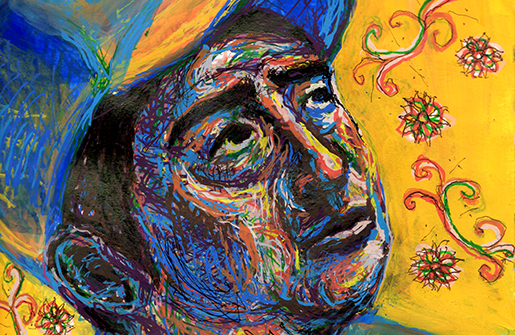
Illustration by Bea Rios
In the dynamic tapestry of our modern era, theological education in Latin America and its widespread diaspora faces two profound crises. These challenges raise questions not only about the relevance of theological education but also its ability to address the pressing issues of our time. On one front, the traditional framework of theological education struggles to confront the deeply ingrained issues of structural and systemic oppression that affect Latin America and its communities across the globe. On another front, theological discourse finds itself at a crossroads, often seen as detached from the pressing realities of everyday life, such as the glaring disparities in human dignity and the urgent need to protect our planet and its diverse
life forms.
This dual crisis reveals deeper wounds: an external deficiency in harnessing a life-affirming version of Christianity to reshape the fabric of societal life, and an internal discord marked by the absence of a theology that is truly incarnational and reflective of the rich tapestry of the peoples and cultures of the Americas and the broader Global South. This predicament in the Global South mirrors a larger global issue within theological education, challenging us to confront our theological and cultural assumptions regarding the Christian itinerary around the world.
The traditional models of theological education, often imported from Western missions, fail to resonate with contemporary needs. Symptoms such as the lack of engaging academic offerings, to decreasing student retention, diminishing church support, inadequate interdisciplinary scholarship, and faltering financial models, to name a few, point to a profound issue: the diminishing relevance of westernized theology to the church, religious institutions, and society at large.
The global pandemic has further amplified these issues, compelling theology and ministry to adapt to a world increasingly mediated by digital platforms. This shift demands a reimagining of theological education that speaks to the hearts and minds of the millennial generation and Generation Z, who navigate these digital realms with ease and bring a fresh, often critical perspective to traditional hyper-local narratives.
In this context, Fuller Seminary’s Centro Latino emerges as a beacon of hope and a model for the future. For half a century, Centro Latino has been at the forefront of theological education, aligned with and at times ahead of Fuller Theological Seminary’s mission, nurturing leaders fluent in Spanish, English, and Portuguese. As a premier Protestant seminary center, Centro Latino offers a comprehensive curriculum in Spanish, carefully crafted to meet the unique needs of the Latina community in North America, the Caribbean, and throughout Latin America. For instance, Centro Latino currently provides academic and professional programs in Spanish, such as an MA in Theology and Ministry, an MDiv (bilingual), a Doctor of Ministry, and professional certificates in various relevant subjects. Most of these programs are cohort-based to ensure success and include a face-to-face component that utilizes the best hybrid-based approaches to contextual education. Additionally, Centro Latino is committed to shaping the character of global leaders by embracing educación en conjunto (collaborative education) with partnering institutions in South America, Central America, and the Caribbean. For the general public, Centro Latino offers original theological conferences called Serie de Master Class, featuring renowned world scholars engaging in impactful scholarship for laypeople.
In summary, with more than 30,000 Latina congregations in the US and a growing population of almost 30 percent identifying as “evangélicas” and 65 percent identifying as “católicas” in Latin America, Centro Latino is ideally positioned to develop leaders from both populations who are not only rooted in faith but are also skilled at addressing the complex socio-political, economic, historical, and cultural challenges of their communities. Our alumni are a testament to this transformative education, actively engaged in various capacities, from church planting and social reform to providing therapeutic support and assuming leadership roles in denominational and academic settings.
Centro Latino’s approach to theological education transcends traditional Westernized boundaries, embracing integrality as a model that prepares leaders to engage with the world through a Christ-centered, contextual lens, equipped with a global perspective for local transformation. This model of education not only shapes leaders but transforms them into agents of integral change, ready to address the world’s most pressing issues with compassion, insight, and unwavering faith.
As we navigate these turbulent times, Centro Latino stands as a guiding light, offering a coherent, compelling, and ultimately inspiring path forward for theological education. Through its commitment to an education deeply rooted in the various Christian traditions of the Americas and responsive to the needs of the contemporary world, Centro Latino not only prepares leaders for today but also shapes the visionaries of tomorrow, ready to make a lasting impact on the world in the power of the Spirit of life and hope.

Oscar García-Johnson is professor of theology and Latino/a studies, also having previously served as Fuller’s chief of diversity, equity, and inclusion and associate dean for Centro Latino. An experienced minister and church planter, he is the author and editor of numerous works, including his current ongoing series Teología del Nuevo Mundo, a revolutionary multivolume exploration of decoloniality, Christian doctrine, intercultural theories, and practical theology to shape the global Christian citizen of the 21st century.
In the dynamic tapestry of our modern era, theological education in Latin America and its widespread diaspora faces two profound crises. These challenges raise questions not only about the relevance of theological education but also its ability to address the pressing issues of our time. On one front, the traditional framework of theological education struggles to confront the deeply ingrained issues of structural and systemic oppression that affect Latin America and its communities across the globe. On another front, theological discourse finds itself at a crossroads, often seen as detached from the pressing realities of everyday life, such as the glaring disparities in human dignity and the urgent need to protect our planet and its diverse
life forms.
This dual crisis reveals deeper wounds: an external deficiency in harnessing a life-affirming version of Christianity to reshape the fabric of societal life, and an internal discord marked by the absence of a theology that is truly incarnational and reflective of the rich tapestry of the peoples and cultures of the Americas and the broader Global South. This predicament in the Global South mirrors a larger global issue within theological education, challenging us to confront our theological and cultural assumptions regarding the Christian itinerary around the world.
The traditional models of theological education, often imported from Western missions, fail to resonate with contemporary needs. Symptoms such as the lack of engaging academic offerings, to decreasing student retention, diminishing church support, inadequate interdisciplinary scholarship, and faltering financial models, to name a few, point to a profound issue: the diminishing relevance of westernized theology to the church, religious institutions, and society at large.
The global pandemic has further amplified these issues, compelling theology and ministry to adapt to a world increasingly mediated by digital platforms. This shift demands a reimagining of theological education that speaks to the hearts and minds of the millennial generation and Generation Z, who navigate these digital realms with ease and bring a fresh, often critical perspective to traditional hyper-local narratives.
In this context, Fuller Seminary’s Centro Latino emerges as a beacon of hope and a model for the future. For half a century, Centro Latino has been at the forefront of theological education, aligned with and at times ahead of Fuller Theological Seminary’s mission, nurturing leaders fluent in Spanish, English, and Portuguese. As a premier Protestant seminary center, Centro Latino offers a comprehensive curriculum in Spanish, carefully crafted to meet the unique needs of the Latina community in North America, the Caribbean, and throughout Latin America. For instance, Centro Latino currently provides academic and professional programs in Spanish, such as an MA in Theology and Ministry, an MDiv (bilingual), a Doctor of Ministry, and professional certificates in various relevant subjects. Most of these programs are cohort-based to ensure success and include a face-to-face component that utilizes the best hybrid-based approaches to contextual education. Additionally, Centro Latino is committed to shaping the character of global leaders by embracing educación en conjunto (collaborative education) with partnering institutions in South America, Central America, and the Caribbean. For the general public, Centro Latino offers original theological conferences called Serie de Master Class, featuring renowned world scholars engaging in impactful scholarship for laypeople.
In summary, with more than 30,000 Latina congregations in the US and a growing population of almost 30 percent identifying as “evangélicas” and 65 percent identifying as “católicas” in Latin America, Centro Latino is ideally positioned to develop leaders from both populations who are not only rooted in faith but are also skilled at addressing the complex socio-political, economic, historical, and cultural challenges of their communities. Our alumni are a testament to this transformative education, actively engaged in various capacities, from church planting and social reform to providing therapeutic support and assuming leadership roles in denominational and academic settings.
Centro Latino’s approach to theological education transcends traditional Westernized boundaries, embracing integrality as a model that prepares leaders to engage with the world through a Christ-centered, contextual lens, equipped with a global perspective for local transformation. This model of education not only shapes leaders but transforms them into agents of integral change, ready to address the world’s most pressing issues with compassion, insight, and unwavering faith.
As we navigate these turbulent times, Centro Latino stands as a guiding light, offering a coherent, compelling, and ultimately inspiring path forward for theological education. Through its commitment to an education deeply rooted in the various Christian traditions of the Americas and responsive to the needs of the contemporary world, Centro Latino not only prepares leaders for today but also shapes the visionaries of tomorrow, ready to make a lasting impact on the world in the power of the Spirit of life and hope.
Oscar García-Johnson is professor of theology and Latino/a studies, also having previously served as Fuller’s chief of diversity, equity, and inclusion and associate dean for Centro Latino. An experienced minister and church planter, he is the author and editor of numerous works, including his current ongoing series Teología del Nuevo Mundo, a revolutionary multivolume exploration of decoloniality, Christian doctrine, intercultural theories, and practical theology to shape the global Christian citizen of the 21st century.
Sergio Zapata Grajales, Fuller alum and professor of New Testament at Fundación Universitaria Seminario Bíblico de Colombia, writes about Jesus’ commitment to following the Father’s leading as a model for Centro Latino’s need to faithfully following God.