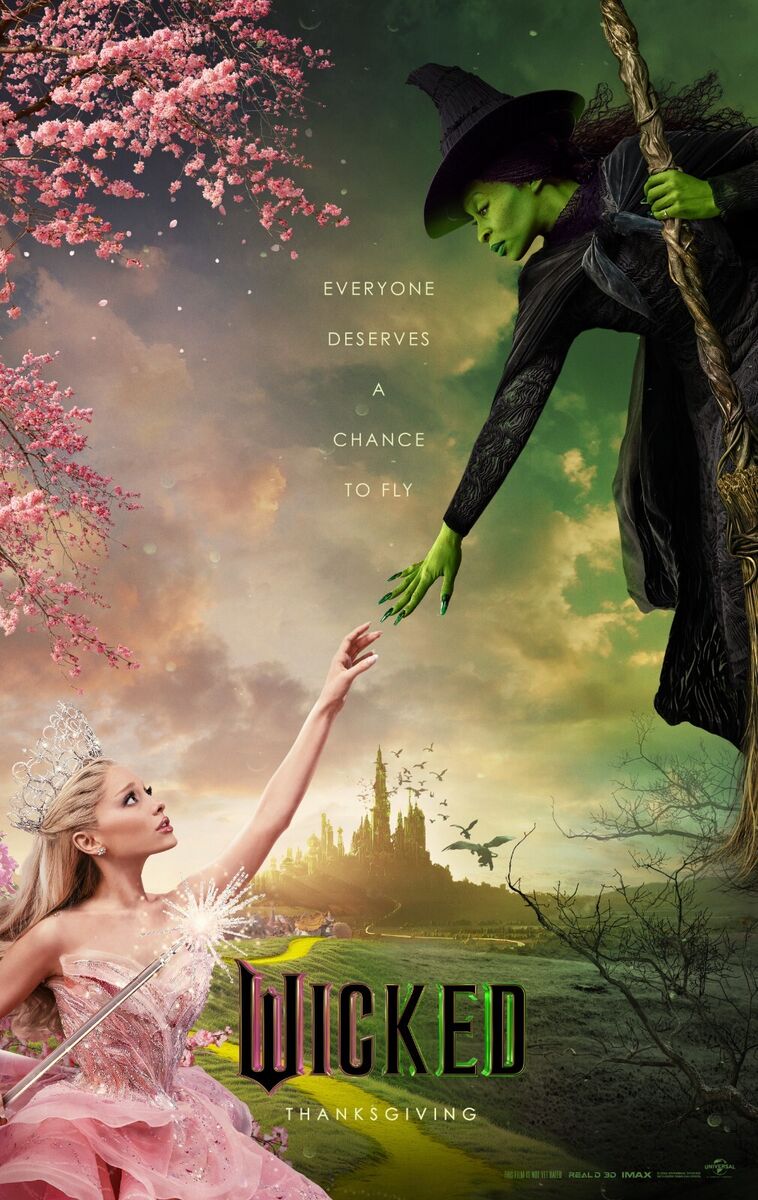
Everything that is good about Wicked: Part One is unrelated to it being a film. The main characters are compelling and well-drawn. The world building, if you are partial to The Wizard of Oz, is intriguing and engrossing. Though we are now familiar with the “school days of adults we know” conceit thanks largely to Wicked, the story is interesting. The themes of marginalization, scapegoating, ambition, and power are explored with nuance and due seriousness. Anthemic power ballads aren’t really my thing, but I’d be lying if I didn’t admit that Wicked’s songs are about as good as they come among their kind. These are narrative elements, and they are common no matter in what medium this story is told, be it a book, a Broadway musical, this film, or even if I recount the story to my kids at bedtime.
However, while I pay attention to and reckon with characters, world building, story, themes, and even ancillary material like songs in my reviews, I do not review those things. I review movies, and as a filmgoing experience I found Wicked to be boring.
A movie is images that move. A movie is light, usually color, movement of the frame and of what is within the frame, cuts between moving images to manipulate time, and, usually, sound working in concert with those other things. We should probably add screen acting (in contrast to stage acting) and intertextual references to that list as well, though those are second order things and not necessary to the existence of a movie. These are all what we call the formal elements of a film. Now, we review narrative films here, so we’re looking at how those formal elements work with the narrative elements to create a, hopefully, excellent film. But we are always considering those formal elements. We are not merely doing narrative criticism.
That’s a lot of preliminary hedging before I get to my review proper of Wicked: Part One, but I think it’s necessary because I feel like a villain saying I do not like this film. People, including people I love, are having a terrific time going to see this movie. I want to be excited along with them. There’s nothing better than enjoying something with someone else, strengthening the relationship through mutual, effusive, outward-facing love. But relationships have to be built on honesty too, and I cannot honestly say I liked this movie. My distaste starts with the light.
This film is lit in a way that erases shadows. There is no contrast in the image. It’s one visual the entire time, and even when the story goes to some darker locations, it’s still a panacea of diffuse light. On top of that, the colors, which, given the cinematic world this story is playing in, should be vibrant, are muted. Yes, there are colors, but they do not pop. There are times when I asked, “What color is that thing?” and I don’t think a movie set in Oz should be bland.
Perhaps the film was lit this way so that the filmmakers could move the camera at will without having to worry about the lighting matching in different camera set ups. I wonder if that’s the case, because my second problem with the film is that it has very little visual continuity between edits. Edits construct the physical space of a movie-world in your mind. They tell you “this is here, and that is there,” and it takes this much time for a character to travel between those places. This is essential filmmaking in any genre, but it is of paramount importance in a dance musical because dance is about bodies moving through space and time in surprising and entertaining ways. Cinematic dancing is about the tension between dancers and between the dancers and the space they are in. Wicked does not build comprehensible space via editing, and so there is no tension in the musical numbers.
Now, I’ve never read the source material or seen the Broadway musical. I’ve never even listened to the cast recording other than hearing “Defying Gravity” everywhere for the past twenty years. So, I don’t know if the movie shuffled any of the plot beats around. I did notice that anytime narrative tension was introduced in the story—Elphaba delivers her sister to school but isn’t staying herself; Elphaba and Galinda don’t get along; the talking animals are being eradicated; is the wizard up to no good; etc.—it was almost immediately dispelled. I read that the show is shorter than this part one film, so maybe in the show when these narrative complications are introduced and then solved they are happening really quickly in sequence with one another, so you’re pulled along by the never-ending chain of them, but in this long movie, a complication is introduced then solved and then a long period of time goes by without narrative tension before another complication is introduced and then immediately solved. So you’re like, “Yeah! Something to care abou– argh!” [thumb twiddle thumb twiddle] “Yeah! Something to care abou– argh!” It’s pacing issue, but if you’re into this to see the musical you like on a big screen, you probably don’t mind.
All that being said, I think Cynthia Erivo, Ariana Grande, and Jonathan Bailey are all terrific. It’s screen acting and it’s pitched just right for the material. It had to be difficult to conceive of performances for the screen that are so iconic on the stage. Cheers to them! Even when I was bored by the movie I enjoyed watching them act.
And the themes are interesting and important. There is a tiny moment of thematic cinematic reference involving Jeff Goldblum and an inflatable moon hearkening back to Charlie Chaplin and a globe that filled me with joy. I have no idea how this story is going to end, but if it encourages people in the audience to think twice before they accept the scapegoating of anyone by someone in or seeking power, all my boredom will have been worth it.
Everything that is good about Wicked: Part One is unrelated to it being a film. The main characters are compelling and well-drawn. The world building, if you are partial to The Wizard of Oz, is intriguing and engrossing. Though we are now familiar with the “school days of adults we know” conceit thanks largely to Wicked, the story is interesting. The themes of marginalization, scapegoating, ambition, and power are explored with nuance and due seriousness. Anthemic power ballads aren’t really my thing, but I’d be lying if I didn’t admit that Wicked’s songs are about as good as they come among their kind. These are narrative elements, and they are common no matter in what medium this story is told, be it a book, a Broadway musical, this film, or even if I recount the story to my kids at bedtime.
However, while I pay attention to and reckon with characters, world building, story, themes, and even ancillary material like songs in my reviews, I do not review those things. I review movies, and as a filmgoing experience I found Wicked to be boring.
A movie is images that move. A movie is light, usually color, movement of the frame and of what is within the frame, cuts between moving images to manipulate time, and, usually, sound working in concert with those other things. We should probably add screen acting (in contrast to stage acting) and intertextual references to that list as well, though those are second order things and not necessary to the existence of a movie. These are all what we call the formal elements of a film. Now, we review narrative films here, so we’re looking at how those formal elements work with the narrative elements to create a, hopefully, excellent film. But we are always considering those formal elements. We are not merely doing narrative criticism.
That’s a lot of preliminary hedging before I get to my review proper of Wicked: Part One, but I think it’s necessary because I feel like a villain saying I do not like this film. People, including people I love, are having a terrific time going to see this movie. I want to be excited along with them. There’s nothing better than enjoying something with someone else, strengthening the relationship through mutual, effusive, outward-facing love. But relationships have to be built on honesty too, and I cannot honestly say I liked this movie. My distaste starts with the light.
This film is lit in a way that erases shadows. There is no contrast in the image. It’s one visual the entire time, and even when the story goes to some darker locations, it’s still a panacea of diffuse light. On top of that, the colors, which, given the cinematic world this story is playing in, should be vibrant, are muted. Yes, there are colors, but they do not pop. There are times when I asked, “What color is that thing?” and I don’t think a movie set in Oz should be bland.
Perhaps the film was lit this way so that the filmmakers could move the camera at will without having to worry about the lighting matching in different camera set ups. I wonder if that’s the case, because my second problem with the film is that it has very little visual continuity between edits. Edits construct the physical space of a movie-world in your mind. They tell you “this is here, and that is there,” and it takes this much time for a character to travel between those places. This is essential filmmaking in any genre, but it is of paramount importance in a dance musical because dance is about bodies moving through space and time in surprising and entertaining ways. Cinematic dancing is about the tension between dancers and between the dancers and the space they are in. Wicked does not build comprehensible space via editing, and so there is no tension in the musical numbers.
Now, I’ve never read the source material or seen the Broadway musical. I’ve never even listened to the cast recording other than hearing “Defying Gravity” everywhere for the past twenty years. So, I don’t know if the movie shuffled any of the plot beats around. I did notice that anytime narrative tension was introduced in the story—Elphaba delivers her sister to school but isn’t staying herself; Elphaba and Galinda don’t get along; the talking animals are being eradicated; is the wizard up to no good; etc.—it was almost immediately dispelled. I read that the show is shorter than this part one film, so maybe in the show when these narrative complications are introduced and then solved they are happening really quickly in sequence with one another, so you’re pulled along by the never-ending chain of them, but in this long movie, a complication is introduced then solved and then a long period of time goes by without narrative tension before another complication is introduced and then immediately solved. So you’re like, “Yeah! Something to care abou– argh!” [thumb twiddle thumb twiddle] “Yeah! Something to care abou– argh!” It’s pacing issue, but if you’re into this to see the musical you like on a big screen, you probably don’t mind.
All that being said, I think Cynthia Erivo, Ariana Grande, and Jonathan Bailey are all terrific. It’s screen acting and it’s pitched just right for the material. It had to be difficult to conceive of performances for the screen that are so iconic on the stage. Cheers to them! Even when I was bored by the movie I enjoyed watching them act.
And the themes are interesting and important. There is a tiny moment of thematic cinematic reference involving Jeff Goldblum and an inflatable moon hearkening back to Charlie Chaplin and a globe that filled me with joy. I have no idea how this story is going to end, but if it encourages people in the audience to think twice before they accept the scapegoating of anyone by someone in or seeking power, all my boredom will have been worth it.

Elijah Davidson is Co-Director of Brehm Film and Senior Film Critic. Subscribe to Come & See, his weekly newsletter that guides you through the greatest films ever made, and find more of his work at elijahdavidson.com.