
Saturday Night is Birdman as written and directed by Aaron Sorkin. This new film, directed by Ivan Reitman, has many of the strengths and weaknesses that description implies. What should we start with, the strengths or the weaknesses? Let’s start with the strengths. Walk and talk with me.
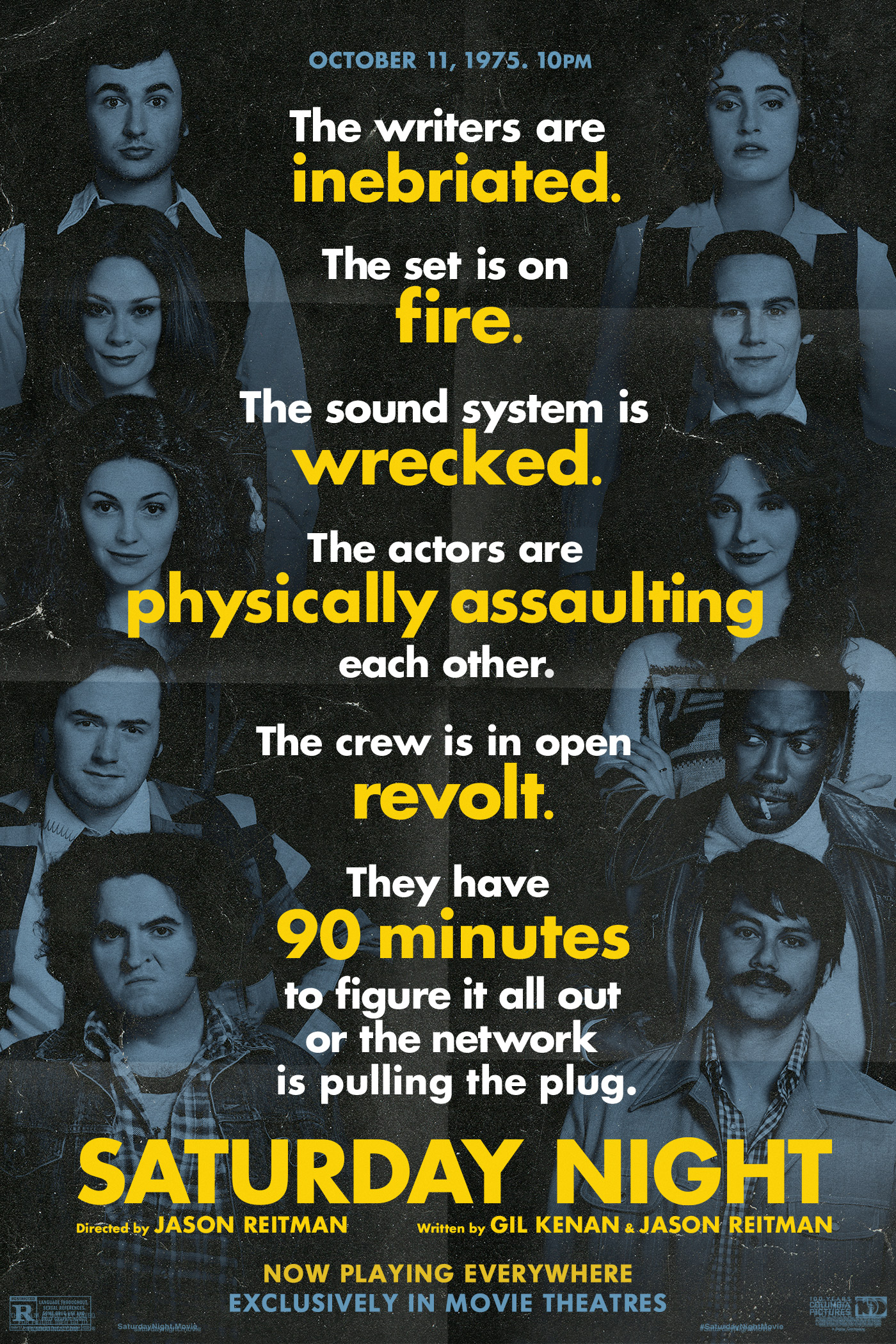
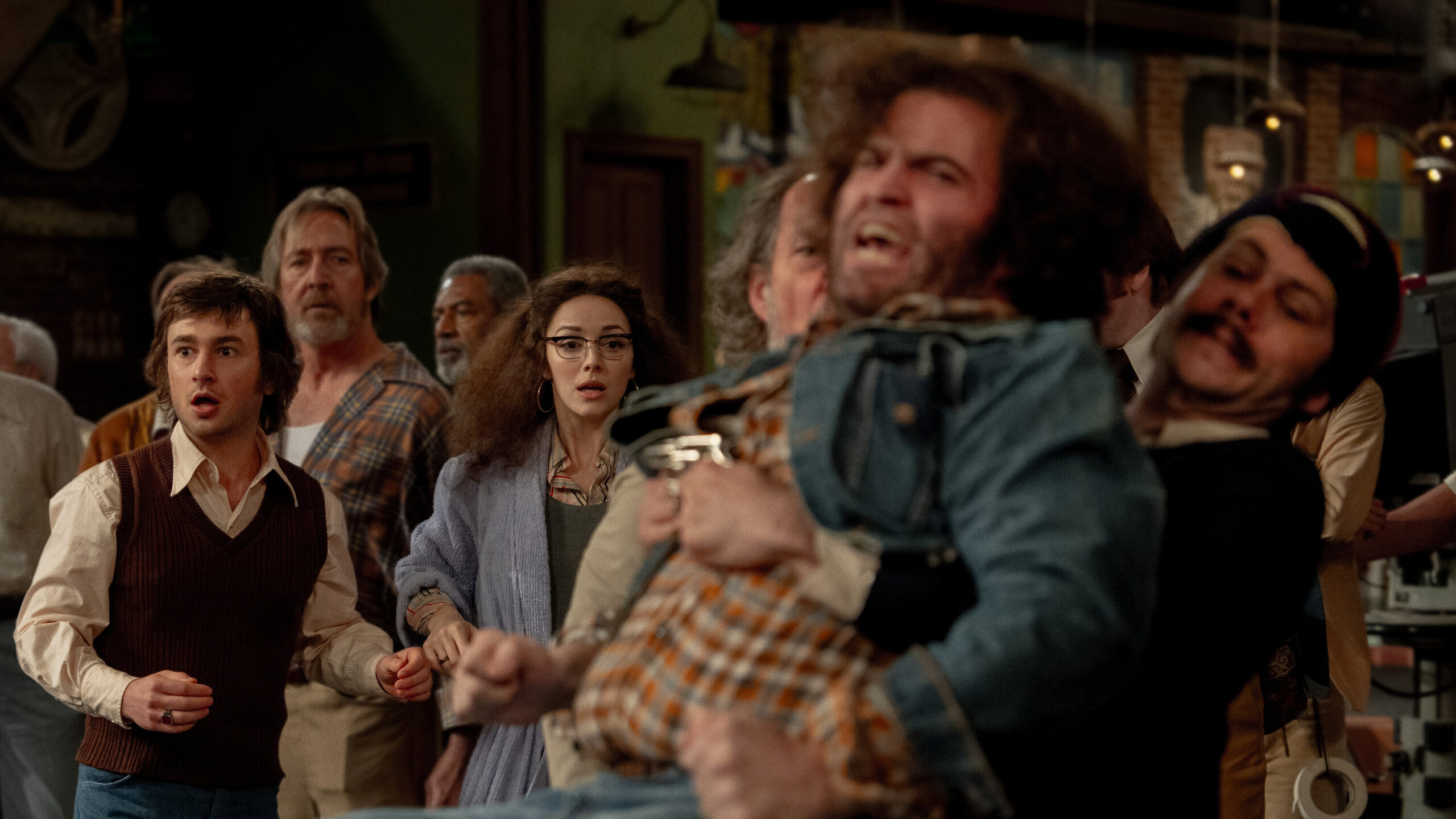
It’s an hour and a half until showtime on the night of the first ever broadcast of the show that will become Saturday Night Live. (That first episode was just called Saturday Night.) The film follows producer Lorne Michaels as he tries to bring everyone together to do this new show. Various then-unknown-but-now-famous people pop up as Michaels navigates the practical (lighting fixtures) and emotional (egos, company politics, interpersonal affairs, etc.) chaos. Will the show go to air? Of course it will. The fun is in watching all the little plots within the big plot arc and resolve. There are plenty of little plots here, and they are mostly all well-handled. You tend to want more of all of them.
The actors playing the now-famous faces are all fun too. Some of them are doing light impressions. Others are just playing the characters as they want to play them. The more recognizable the antecedent, the more impression-y the performance tends to be. It’s a good mix. I liked some characterizations and little plots more than others; I’m sure your favorites will differ from mine. For me, Rachel Sennott and Lamorne Morris steal the show, but you might very well find some other actor/character more enthralling. There are plenty to go around.
Movies with foregone conclusions are never about “if” the historical event will occur. They are about “how” it occurred. Better, they are about an idealized, hopefully entertaining version of how something occurred which provides some kind of lesson or encouragement for our lives today. There are mid-tier Sorkin-esque inspirational moments of emotional clarity and thematic lift sprinkled throughout Saturday Night: “Look out for the little guy.” “Come together across differences.” “Believe in your dream.” “Everyone has a place in this ragtag community.” et cetera, et cetera, et cetera. Be a person like Lorne Michaels, and you, too, might create something as iconic as Saturday Night Live. It’s Frank Capra if Frank Capra only made movies about how tough yet worthwhile it is for Frank Capra to make movies.
So maybe Saturday Night, like Birdman, is a shade too navel-gazy and inauthentically anxious, and maybe, like Sorkin’s worst, there’s something self-importantly smug about the whole affair, but you know, I think those things are true of Saturday Night Live as well, and it can be that and still be fun to watch because when it lands, it lands big and becomes the source of culturar moments we all share.
The people who make the show should be proud of that. Saturday Night Live stopped being a show and became the same kind of cultural institution it was, apparently, created to contradict. Cultural institutions need some swagger. I’d rather live in a society where a show like Saturday Night Live is an institution than in one where it is not. The next revolution won’t look like the last one, but it will be motivated by the same desires. Whichever side of the glass wall you end up on—in the gallery with the clowns or in the booth with the affiliates—remember why you got involved in this thing in the first place. That’s what Saturday Night is about.
Saturday Night is Birdman as written and directed by Aaron Sorkin. This new film, directed by Ivan Reitman, has many of the strengths and weaknesses that description implies. What should we start with, the strengths or the weaknesses? Let’s start with the strengths. Walk and talk with me.
It’s an hour and a half until showtime on the night of the first ever broadcast of the show that will become Saturday Night Live. (That first episode was just called Saturday Night.) The film follows producer Lorne Michaels as he tries to bring everyone together to do this new show. Various then-unknown-but-now-famous people pop up as Michaels navigates the practical (lighting fixtures) and emotional (egos, company politics, interpersonal affairs, etc.) chaos. Will the show go to air? Of course it will. The fun is in watching all the little plots within the big plot arc and resolve. There are plenty of little plots here, and they are mostly all well-handled. You tend to want more of all of them.
The actors playing the now-famous faces are all fun too. Some of them are doing light impressions. Others are just playing the characters as they want to play them. The more recognizable the antecedent, the more impression-y the performance tends to be. It’s a good mix. I liked some characterizations and little plots more than others; I’m sure your favorites will differ from mine. For me, Rachel Sennott and Lamorne Morris steal the show, but you might very well find some other actor/character more enthralling. There are plenty to go around.
Movies with foregone conclusions are never about “if” the historical event will occur. They are about “how” it occurred. Better, they are about an idealized, hopefully entertaining version of how something occurred which provides some kind of lesson or encouragement for our lives today. There are mid-tier Sorkin-esque inspirational moments of emotional clarity and thematic lift sprinkled throughout Saturday Night: “Look out for the little guy.” “Come together across differences.” “Believe in your dream.” “Everyone has a place in this ragtag community.” et cetera, et cetera, et cetera. Be a person like Lorne Michaels, and you, too, might create something as iconic as Saturday Night Live. It’s Frank Capra if Frank Capra only made movies about how tough yet worthwhile it is for Frank Capra to make movies.
So maybe Saturday Night, like Birdman, is a shade too navel-gazy and inauthentically anxious, and maybe, like Sorkin’s worst, there’s something self-importantly smug about the whole affair, but you know, I think those things are true of Saturday Night Live as well, and it can be that and still be fun to watch because when it lands, it lands big and becomes the source of culturar moments we all share.
The people who make the show should be proud of that. Saturday Night Live stopped being a show and became the same kind of cultural institution it was, apparently, created to contradict. Cultural institutions need some swagger. I’d rather live in a society where a show like Saturday Night Live is an institution than in one where it is not. The next revolution won’t look like the last one, but it will be motivated by the same desires. Whichever side of the glass wall you end up on—in the gallery with the clowns or in the booth with the affiliates—remember why you got involved in this thing in the first place. That’s what Saturday Night is about.

Elijah Davidson is Co-Director of Brehm Film and Senior Film Critic. Subscribe to Come & See, his weekly newsletter that guides you through the greatest films ever made, and find more of his work at elijahdavidson.com.
Autobiography is an exercise in making sense of what was actually just a random series of events. It’s putting together pieces into a whole. It’s not real, so in that sense, the use of LEGO is appropriate.