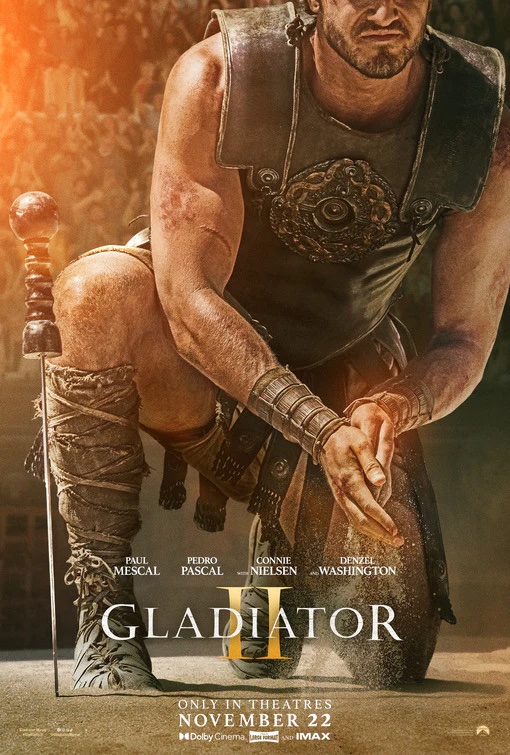
I have long maintained that it would be impossible to make a sequel to Ridley Scott’s Gladiator because Joaquin Phoenix chewed up the scenery in that first film so completely there was nothing left to work with. Well, Ridley Scott proved me wrong. Not only did he make a sequel, but he found actors just as capable of cinematic mastication. The multiple-Oscar-winning Gladiator was gristle so skillfully cooked it was delicious. Gladiator II, on the other hand, is taffy, which isn’t to say it’s not tasty. It’s just not a meal in the same way its predecessor was.
I could go into detail about how the filmmakers connect this film to the previous installment, but two thousand words later you’d either be bored or numb. Suffice it to say there are returning characters, returning political tensions, returning set pieces amped up a degree or two, and a thick sauce of reverence for the first film’s hero slathered over everything. There’s a literal shine to Maximus Decimus Meridius—”commander of the Armies of the North, General of the Felix Legions and loyal servant to the true emperor, Marcus Aurelius. Father to a murdered son, husband to a murdered wife,” etc.—in the movie. We’ve taken to calling these kinds of movies “legacyquels.” They are sequels made many years after their original films that smack of intellectual property extension and usually revolve around passing the torch to a new generation. They often feature Harrison Ford.
Gladiator II doesn’t have Harrison Ford but it does have Denzel, and his performance alone is worth the price of admission. Is that really a surprise? Denzel always delivers, and the movie he is in is a Roman riot the likes of which we haven’t seen, at least not this graphically. Charlton Heston never dared to play a character this big.
The rest of the cast is in a different movie though. They are all fine. They’re doing their best to breathe life into Gladiator’s long-dead corpse, but there is only so much they can do. The movie lacks the clarity of purpose of the original film. The actors aren’t served by the muddledness.
If you want, you can wonder why we’re still telling stories about ancient Rome two thousand years later. You can contemplate our desire to be entertained while the empire crumbles around us. You can ponder Gladiator II’s assertion that violence is the universal language. That line could serve as a tag line for a box set of Ridley Scott’s films, couldn’t it? You could dream the dream that was Rome and lament the state it always falls into. The movie sends all those things at you on the backs the rabid baboons, Colosseum-swimming sharks, and a fight with a rhinoceros I’ve been wanting to see since I discovered some pre-vis work hidden like an Easter egg on my DVD copy of Gladiator twenty years ago. It feels like a promise kept.
I have long maintained that it would be impossible to make a sequel to Ridley Scott’s Gladiator because Joaquin Phoenix chewed up the scenery in that first film so completely there was nothing left to work with. Well, Ridley Scott proved me wrong. Not only did he make a sequel, but he found actors just as capable of cinematic mastication. The multiple-Oscar-winning Gladiator was gristle so skillfully cooked it was delicious. Gladiator II, on the other hand, is taffy, which isn’t to say it’s not tasty. It’s just not a meal in the same way its predecessor was.
I could go into detail about how the filmmakers connect this film to the previous installment, but two thousand words later you’d either be bored or numb. Suffice it to say there are returning characters, returning political tensions, returning set pieces amped up a degree or two, and a thick sauce of reverence for the first film’s hero slathered over everything. There’s a literal shine to Maximus Decimus Meridius—”commander of the Armies of the North, General of the Felix Legions and loyal servant to the true emperor, Marcus Aurelius. Father to a murdered son, husband to a murdered wife,” etc.—in the movie. We’ve taken to calling these kinds of movies “legacyquels.” They are sequels made many years after their original films that smack of intellectual property extension and usually revolve around passing the torch to a new generation. They often feature Harrison Ford.
Gladiator II doesn’t have Harrison Ford but it does have Denzel, and his performance alone is worth the price of admission. Is that really a surprise? Denzel always delivers, and the movie he is in is a Roman riot the likes of which we haven’t seen, at least not this graphically. Charlton Heston never dared to play a character this big.
The rest of the cast is in a different movie though. They are all fine. They’re doing their best to breathe life into Gladiator’s long-dead corpse, but there is only so much they can do. The movie lacks the clarity of purpose of the original film. The actors aren’t served by the muddledness.
If you want, you can wonder why we’re still telling stories about ancient Rome two thousand years later. You can contemplate our desire to be entertained while the empire crumbles around us. You can ponder Gladiator II’s assertion that violence is the universal language. That line could serve as a tag line for a box set of Ridley Scott’s films, couldn’t it? You could dream the dream that was Rome and lament the state it always falls into. The movie sends all those things at you on the backs the rabid baboons, Colosseum-swimming sharks, and a fight with a rhinoceros I’ve been wanting to see since I discovered some pre-vis work hidden like an Easter egg on my DVD copy of Gladiator twenty years ago. It feels like a promise kept.

Elijah Davidson is Co-Director of Brehm Film and Senior Film Critic. Subscribe to Come & See, his weekly newsletter that guides you through the greatest films ever made, and find more of his work at elijahdavidson.com.