

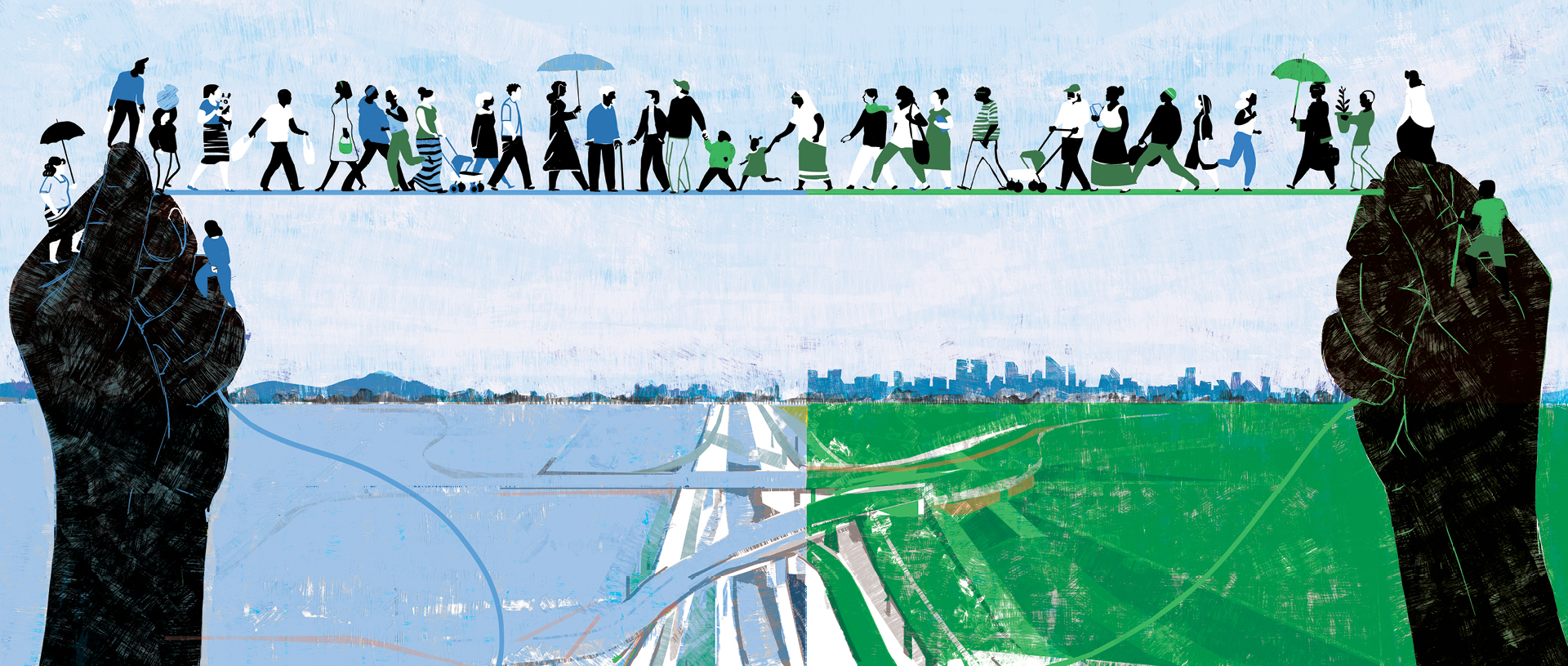
When you’re a Bible teacher like I am, and after a national election like the one we’ve just endured, it’s tempting to hide in the conceit that what you do is largely unrelated to “politics.” The same conceit inspires the moribund Christian platitudes that, lately and predictably, have been spinning airily from the electoral noise: “God is on the throne no matter who is elected”; “I follow the Lamb, not the donkey or the elephant.” If you study the Bible with any care, you know that you can afford no such conceit and that the Bible knows nothing of such detachment.
Yet, if you study the Bible with any care, you also know to be uneasy with the stock we have in an electoral system awash with mammon, one that strikingly represents the casino that is US society. National elections, especially at the top of the ticket, come down to a beauty contest and, as such, aggravate our collective ugliness. You would think that the gaping disparity between the spectacle of campaign performances and how candidates prove to govern would enervate our zeal for being manipulated, or at least make us less amenable to it. But we seem to be stuck in the histrionics of “world wrestling” for our national politics.
Our civic piety rushes to arrest any attitude that smacks of cynicism, reminding us sanctimoniously that there are far worse ways to distribute power. But this is another moribund platitude with which we coddle ourselves. That things could be worse does not make them acceptable. Our pundits now gravitate blithely to sport as an apt pool of metaphors for tracking our national elections, as if how we shape government should be comparable to sport. Indeed, it is a sport, but it is a blood sport. When it comes to the electoral distribution of power, we should demand more and work for better.
Perhaps we have not demanded more because, sooner or later across election cycles, “we” win, whatever worship of the devil it may require of us. But making a sport of distributing political power courts a future we will lament. And that lament will be especially bitter if it mourns outcomes we have produced by periodically “winning.” Our civic religion and media culture press us to see ourselves meaningfully represented by a vote for one or another of the political options served up for us by the current priests of mammon. Not coincidentally, this representation is relentlessly inimical to our national adversaries and animated by that antagonism. And in electoral contests, the blood we smell—and eventually taste if we’re lucky enough to “win”—is life that we have sacrificed to the national gods. Yet, as Jesus shows us, the blood we shed and consume is always, eventually, our own.
Some of Jesus’s partisan opponents—on his own path to bloody enthronement on a Roman cross of shame—sought to induce a gaffe from him that would derail his rise to power. At his people’s annual festival of freedom, they asked him, “Is it right to pay a tax to Caesar or not?” That is, “Should we declare war on Rome or settle for Rome’s dominance of our life?” After asking for a Roman coin, Jesus answered, “Render the things of Caesar to Caesar and the things of God to God.” These words have been systematically misinterpreted to separate religion from politics, fueling a Christianity that has often posed as the detached, pious façade of what is, in truth, idolatrous political ambition and actual state power. Today, a politically “innocent” Christianity is well exposed for the masquerade it has always been.
Contrary to what you’ll hear nearly every time the words of Jesus’s answer are repeated, he draws no line between religion and politics. He would hardly have gotten himself executed for sedition against Rome a few days later if he did. Instead, he warns against the representation of his people’s calling with a coin. That coin, he teaches, will hold whatever weight they collectively give to it; its weight is determined by how they share power, wealth, and imagination over time. And the more weight they sacrifice to Caesar, the more he and other priests of mammon will claim. Meanwhile, God claims all of them—the love of their whole heart, mind, and strength—to be expressed in how they treat one another, not least in how they share wealth. So let not the things of Caesar be sacralized as the measure of Israel’s life and calling.
Why should the things of Caesar not be sacralized? Why can’t the people of God determine the weight of their calling with the question of whether to pay a tax to Caesar? Because that is to allow Caesar and his terms to claim what belongs to God. So, sure, Jesus says, give Caesar his stupid coins, but give to God all that is God’s so that, one day, Caesar will have nothing left to claim.
Given the likely consequences in the next four years and surely beyond, one of the two presidential candidates in this past election was a particularly egregious choice, in my view. But it is also a misjudgment to imagine that the US electoral system and our partisan options—which largely reduce people to convulsive, atomized votes in favor of one and against another—adequately represented real people. People are much too wondrous to be so represented, and settling for such representation—such coin—leads us to know ourselves as poorly as we know others. Here I differ with Senator Warnock, for whom I would have voted without hesitation in 2020 if I lived in Georgia: A vote in US electoral politics is not, in fact, a kind of prayer. At least, not a prayer to the God of the Bible. Prayers cannot be counted.
The call of the people of God is to love much more and much better than a vote in our current electoral system can do, to render unthinkable the determination of the life we share with others by means of a blood sport or a beauty contest. We must demand more than a casino for our life together. And we can, if we are willing to forge thicker political and economic bonds with our neighbors, whoever they are, in the places where we live.

Tommy Givens is associate professor of New Testament