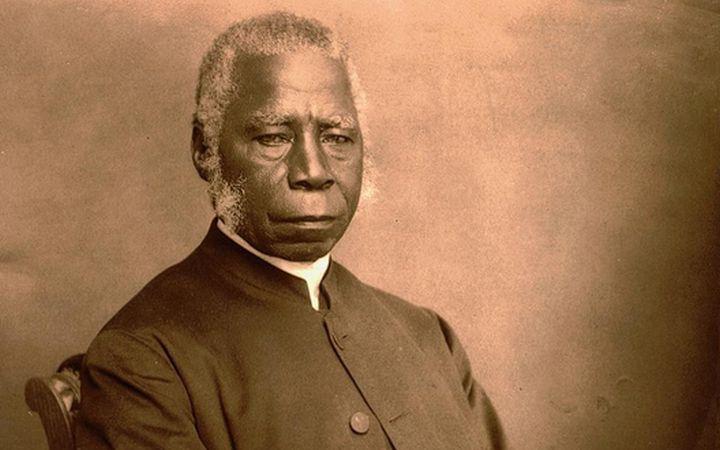
In light of the upcoming Missiology Lectures (November 13-15) at Fuller Seminary entitled, “Still a Pluralist? Lesslie Newbigin in the Twenty-First Century”, we begin a series of articles that highlight the role and contribution of historical interfaith pioneers. This week’s pioneer is Samuel Ajayi Crowther.
Ordained as the first African Anglican bishop in 1864, Samuel Ajayi Crowther (1809-1891) was probably the most widely known African Christian of the nineteenth century. Crowther presided over “the first sustained missionary engagement with African Islam in modern times.”
Within the Western missionary movement the encounter with Islam involved an approach that typically focused on (1) confrontational debate, (2) polemical defense of Christian doctrine, and (3) denunciations of Islam as a false religion. Crowther’s approach to Christian-Muslim engagement was strikingly different. He had learned from painful experience among Muslims in Sierra Leone that confrontational debate simply did not work; that the noble effort to win arguments by promoting or defending Christian doctrine only succeeded in arousing hostility, bewilderment, and rejection. Over time, he developed what might be termed a uniquely African Christian approach to Islam that incorporated three elements.
First, it was non-confrontational.1 Crowther was careful not to attack Islam and he determined (in his own words) that “our missionary operations under Mohammedan government should not be disputes about the truth or falsehood of one religion or another, but they should aim at toleration.”
Second, it was almost exclusively Bible-based, which is to say that in his interactions with Muslims, Crowther insisted on using actual words from Scripture (quoting specific passages) in response to all queries rather than take a stance on “traditional formulations of Christian doctrine.” He was convinced that the Bible should be allowed to speak for itself. As he put it, “after many years of experience, I have found that the Bible, the sword of the Spirit, must fight its own battle, by the guidance of the Holy Spirit.”
Third, Bishop Crowther’s approach to Islam emphasized vernacular translation. Crowther was wholly committed to the principle of vernacular translation. He spent almost all his life involved in the translation of the Bible into Yoruba. He made the translation of Scriptures into African languages a centerpiece of his mission strategy. In the Niger, where the local languages were unknown to him and his agents, he emphasized the need to collect words and sentences in the local dialects “so as to be able in the course of time to make a primer and a vocabulary of the language.”
Endnotes
1For a more thorough treatment of Crowther, see Jehu J. Hanciles 2008. In the shadow of the elephant : Bishop Crowther and the African missionary movement. Oxford: CA Church Mission Society. See also Andrew F. Walls. 1992. “The legacy of Samuel Ajayi Crowther.” International Bulletin of Missionary Research no. 16 (1):15-16,18-21.